Understanding the Limits of Household Cleaning After Biological Contamination
Household cleaning is fine for a small spill of blood on a hard, sealed surface, such as a kitchen counter or a tiled floor, when a household follows general public-health guidance. It stops being enough when the contamination is large, has soaked into porous materials, may have spread out of sight, or comes from an event that is emotionally hard to face.
This guide explains why that line exists, what official guidance says in general terms, the common ways well-meant cleaning goes wrong, and how to tell which side of the line you're on.
If you are cleaning up after someone you love has died by suicide and you are struggling, you can call or text 988 or chat at 988lifeline.org to reach the 988 Suicide & Crisis Lifeline.
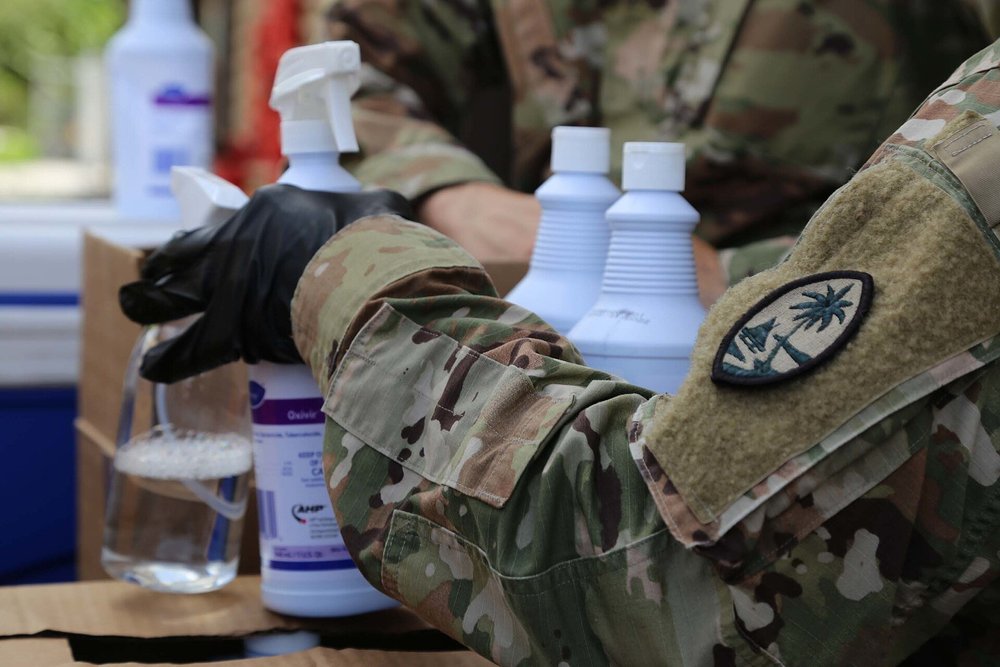
Photo: The National Guard, public domain, via Wikimedia Commons
Where the line falls between household and professional cleanup
The line isn't about how determined you are or how strong your cleaning products are. It's about three things: size, surface and situation.
Usually manageable at home
- A small spill, such as from a cut finger or a nosebleed.
- On a hard, sealed, non-porous surface: sealed tile, a countertop, a sink, glass.
- Found right away, before it has dried into cracks or seams.
- An ordinary household moment that doesn't carry emotional weight.
Calls for professional help
- Anything larger than a small, contained spill.
- Blood or bodily fluids on carpet, upholstery, mattresses, unsealed wood or drywall.
- Contamination that may have reached beneath flooring or behind trim.
- Any situation following a death, serious injury, crime or suicide.
- A space where odor suggests something is still present.
If you're unsure, treat the situation as one for professionals. It costs nothing to ask, and a phone call can often settle the question in a few minutes.
What public-health guidance says, in general terms
Official guidance on handling blood and bodily fluids is written mainly for workplaces such as hospitals, but its basic principles help explain why household methods have limits. This section describes those principles. It is not a set of instructions for cleaning anything beyond a small spill on a hard surface.
Clean first, then disinfect
CDC guidance separates two steps: removing visible material, and then disinfecting the surface. Disinfectants work poorly when organic material is still present, which is why simply spraying a product onto a spill doesn't accomplish much.
Use a registered product as its label directs
The EPA registers disinfectants, and the label on each product sets out how to use it. EPA guidance emphasizes reading the label before use and keeping the surface visibly wet for the full contact time stated there. Products that carry claims against bloodborne pathogens are now grouped on EPA's List S.
Never mix products
CDC warns never to mix household bleach, or any disinfectant, with other cleaners or disinfectants, because some combinations release dangerous vapors. Ventilation and appropriate protection such as gloves are part of the same guidance.
Some materials can't be fully decontaminated
CDC's environmental infection control guidance notes OSHA's position that carpeting contaminated with blood or other potentially infectious materials cannot be fully decontaminated. That single point explains much of why household cleaning falls short in real homes, where floors are often carpeted.
For the small, hard-surface spills that households do handle, the safe approach is to follow current CDC and public-health guidance and the directions on the product label. For anything else, the principles above are reasons to stop, not a recipe.
Why the type of surface changes everything
The single biggest limit of household cleaning is that it works on surfaces, and many contaminated materials aren't just surfaces.
Non-porous surfaces
Glass, sealed stone, glazed tile, metal and finished countertops have a closed face. Liquid sits on top. A spill can be lifted off, and a disinfectant can touch everything that was contaminated. This is the situation general guidance is built for.
Porous materials
Carpet, carpet pad, mattresses, upholstery foam, fabric, unsealed wood, paper and drywall are full of tiny spaces. Liquid moves into them and spreads sideways and downward. A household cleaner applied from above reaches the top layer, but not what has soaked below. Scrubbing can even push material deeper.
Joints and seams
Even hard floors have weak points. Grout lines, gaps between floorboards, seams in vinyl and the edge where a floor meets a wall all let liquid escape the surface. What looks like a cleaned tile floor may still have contamination beneath the baseboard.
Our guide on how professionals determine whether materials can be remediated explains how each material is judged, and what happens to contaminated porous materials covers removal.
The health reasons, stated calmly
The reason for care isn't panic. It's that some infections travel in blood. The CDC notes that bloodborne pathogens such as hepatitis B, hepatitis C and HIV can be spread through contact with infected blood. You can't tell by looking whether blood carries any of them.
That's why workplaces where employees are exposed to blood follow the federal Bloodborne Pathogens Standard, 29 CFR 1910.1030. Among other things, it requires employers to provide protective equipment and training, and it says contaminated broken glass must not be picked up directly with the hands. The standard applies to employers, not households, but it shows how seriously exposure is taken by people who handle it every day.
The standard also recognizes that blood isn't the only concern. It defines "other potentially infectious materials," a group that includes certain body fluids and any body fluid visibly contaminated with blood. In practice, this means a scene involving bodily fluids deserves the same caution as one involving blood.
None of this means a small household spill is dangerous when handled sensibly. It means that larger contamination, hidden contamination and contamination on absorbent materials carry exposure risks that household methods aren't designed to manage.
Common mistakes with well-meant cleaning
People who try to clean after a serious event almost always do it out of love or responsibility. Unfortunately, a few common steps can make the situation harder to resolve.
- Mixing products for extra strength. Combining bleach with other cleaners can release harmful vapors. CDC guidance is clear that products should never be mixed.
- Scrubbing carpet or upholstery. This can spread contamination wider and push it deeper into pad and cushioning.
- Using a carpet cleaner or wet vacuum. These machines can draw contaminated liquid into their tanks and hoses and spread moisture further into the floor.
- Running fans to dry or air out the room. Moving air from an affected room into clean ones can spread odor. It's better to keep the door closed and avoid running fans or HVAC into the area where that's easy to arrange.
- Masking odor. Air fresheners and candles cover the symptom while the source remains.
- Bagging and binning items. Contaminated material shouldn't go out with household trash, and your insurer may want to see items before they're discarded.
- Painting or re-flooring over a stain. Covering a contaminated surface doesn't remove what's beneath it.
If some of this has already happened, don't worry. Just tell us what was done when you call, so the assessment can account for it. Our guide on what not to do before an assessment covers more.
The emotional limit is real too
Not every limit is physical. Cleaning a space where someone you love was hurt or died can be deeply distressing, and it can stay with you long afterward. Families sometimes feel they ought to do it themselves, out of duty or privacy or a wish to protect others. That impulse is understandable. It's also fine to set it down.
Asking for help is not a failure of care. It lets you spend your energy on the people around you and on everything else that follows a loss. If a friend or relative offers to help, a useful thing they can do is make the phone call for you, not pick up a sponge. Our guide on communicating with a cleanup company explains how someone else can arrange things on your behalf.
If a death by suicide is part of what you're dealing with and you're having a hard time, the 988 Suicide & Crisis Lifeline is available by call or text at 988, or by chat at 988lifeline.org, at any hour.
Situations that move even a small job across the line
Some details turn what looks like a manageable spill into something better left to professionals, regardless of size.
Sharp objects or needles
Broken glass, needles or other sharp items in or near biological material raise the risk of a cut that brings blood directly into contact with the skin. OSHA's standard for workplaces says contaminated broken glass shouldn't be picked up by hand at all. If sharps are present, leave the area alone and mention them when you call.
Vehicles
Car interiors are mostly absorbent: seat foam, fabric, carpet and padding. Fluid also collects in gaps around seats and under floor coverings. Even a modest amount in a vehicle tends to reach places a household can't. See vehicle biohazard cleanup.
Rentals and shared buildings
In a rental or apartment, the property owner or manager usually needs to know and to decide how the unit is handled. Cleaning quietly can create disputes later about damage, deposits or disclosure to the next resident. The rental property blood cleanup page covers how owners and tenants usually divide responsibility.
Workplaces
Employers whose staff have occupational exposure to blood have obligations under the Bloodborne Pathogens Standard. Asking an employee without training or protective equipment to clean up blood is a different matter from a homeowner wiping a counter. Businesses can read about blood cleanup in commercial buildings.
Older or unwell household members
If the person who would do the cleaning is elderly, pregnant, has a weakened immune system or has cuts on their hands, that's another reason to hand the job off.
What professional cleanup does differently
Professional biohazard cleanup isn't household cleaning done harder. It's a different process built around the limits described above.
| Household cleaning | Professional remediation |
|---|---|
| Works on visible surfaces | Starts with an assessment of what's beneath and behind surfaces |
| Tries to clean porous items in place | Removes contaminated porous materials that can't be reliably decontaminated |
| Uses whatever products are on hand | Uses EPA-registered disinfectants according to label directions, including contact time |
| Ordinary gloves, if any | Protective equipment chosen for the job; see cleanup equipment and PPE |
| Can spread contamination to clean rooms | Sets up the work area to keep contamination contained; see access and containment |
| Waste goes in household trash | Waste is packaged and disposed of in line with applicable Tennessee and federal requirements |
| No record of what was done | Photos, written scope and itemized invoice for owners and insurers |
On waste specifically: in Tennessee, medical waste is a special waste and generally can't be sent to a landfill unless it has been treated to be non-infectious. That's a practical reason contaminated materials from a serious event shouldn't be put out with the regular garbage. For a broader comparison, see crime scene cleanup versus general cleaning.
What you can safely do in the meantime
If the situation is beyond household cleaning, the most helpful things you can do don't involve cleaning at all:
- If anyone is hurt or in danger, call 911 first.
- If police or the medical examiner are involved, wait until they've released the property.
- Keep people and pets out of the affected area.
- Close the door to the room if you can easily do so.
- Avoid running fans or the HVAC system into the area where that's simple to arrange.
- Don't throw items away until you've spoken with your insurer.
- Call a professional to talk the situation through.
That's genuinely all that's needed from you. The rest is what an assessment and written scope are for. Our guide to why professional biohazard cleanup may be necessary explores the decision further.
Cost, insurance and making a sensible choice
Some people try household cleaning first because they're worried about cost. That's a reasonable concern, and it's worth knowing a few things before deciding.
- Price is based on a written scope. It reflects the extent of contamination, the materials involved, the number of rooms, access and waste volume. You can ask what's driving the price before approving anything. See how pricing works.
- Insurance may help, depending on your policy. Some property insurance policies may cover some of this work; coverage depends entirely on the policy and the insurer. Cleaning before an adjuster sees the area, or throwing items away, can make a claim harder. Our guide to insurance questions after a biohazard incident lists what to ask.
- Crime victims may have help available. Tennessee's Criminal Injuries Compensation program can pay toward cleaning and removal of materials when a crime happened in the victim's or an eligible relative's home, subject to its rules. Details are on the TN Treasury website.
- Incomplete cleaning can cost more later. If contamination remains under flooring or in furniture, odor and further damage can make a second effort larger than the first.
Knowing when to set the sponge down
Household cleaning has a proper place: small spills on hard, sealed surfaces, handled with care according to general CDC guidance and the product label. Beyond that, its limits are built in. Ordinary methods can't reach contamination that has soaked into porous materials or spread out of sight, they can spread it further, and they can't address the waste or the records that follow.
There's also a human limit. Nobody should feel obliged to clean up after a loss. If you're uncertain which side of the line you're on, call (615) 513-5112 or contact us. You can also browse our blood cleanup and bodily-fluid cleanup services, or see how we handle residential biohazard cleanup across Middle Tennessee.
Questions people ask
Is bleach enough to clean up blood?
For a small spill on a hard, sealed surface, a properly diluted, registered disinfectant used according to its label, after the visible material is removed, is in line with general CDC guidance. Bleach can't fix contamination that has soaked into carpet, upholstery, mattresses or wood, and it should never be mixed with other cleaners.
Can I rent a carpet cleaner to deal with a blood stain?
For anything more than a tiny spot, it isn't a good idea. Carpet machines push liquid into the pad and subfloor and can draw contaminated material into the machine. CDC guidance notes OSHA's view that contaminated carpet can't be fully decontaminated.
The stain is gone but there's still a smell. What does that mean?
It usually means biological material remains somewhere you can't see, often in carpet pad, subfloor or furniture cushioning. Fragrance won't solve it. An assessment can find the source.
I already tried to clean. Did I make things worse?
Possibly a little, but it's common and it's fixable. Stop where you are, keep people out of the area, and tell us what was done so the assessment can account for it. There's no judgment in that conversation.
Is it dangerous to be in the same house as the affected room?
Keeping people and pets out of the affected area and closing the door is a sensible precaution. Bloodborne infections spread through contact with infected blood, so avoiding contact is the main thing. If anyone has been exposed and is worried, talk to a doctor.
Can I throw contaminated items out with the trash?
It's better not to. Contaminated material is packaged and disposed of according to applicable Tennessee and federal requirements, and your insurer may want items documented before they're discarded.
How do I know if a spill is small enough to handle myself?
If it's a small amount, on a hard sealed surface, found promptly, and not connected to a death, serious injury or crime, a household can generally follow CDC guidance. If any of those don't apply, or you simply don't want to, call for help.
Does dried blood need different handling from a fresh spill?
Dried blood on a hard surface is still something a household can address under general guidance if the area is small. On fabric, carpet or wood, drying usually means the material has had time to absorb it, which makes removal of the material more likely. See our page on dried blood cleanup.
Sources
- CDC: Cleaning and Disinfecting with Bleach
- CDC: Environmental Infection Control Guidelines, environmental services
- EPA: Selected EPA-Registered Disinfectants
- CDC/NIOSH: Bloodborne infectious diseases
- OSHA Bloodborne Pathogens Standard (29 CFR 1910.1030)
- TDEC Special Waste guidance (medical waste)
- 988 Suicide & Crisis Lifeline
Not sure which side of the line you're on?
Call (615) 513-5112 and describe the situation in plain terms. If it's something a household can manage with general guidance, we'll say so; if it isn't, we'll explain the next step.