Post-Incident Biohazard Remediation
Post-incident remediation is the work that happens after the investigation ends. Once police and the county medical examiner release a property following a traumatic death, including a death by suicide, the space is handed back to its owner as it was left. Remediation turns it back into a place people can safely use.
This page walks through that phase from start to finish: assessment, removal, disinfection, odor, documentation, and the moment we hand the keys back.
If the events that led you here have left you feeling overwhelmed or unsafe, the 988 Suicide & Crisis Lifeline is free and confidential: call or text 988, or chat at 988lifeline.org.
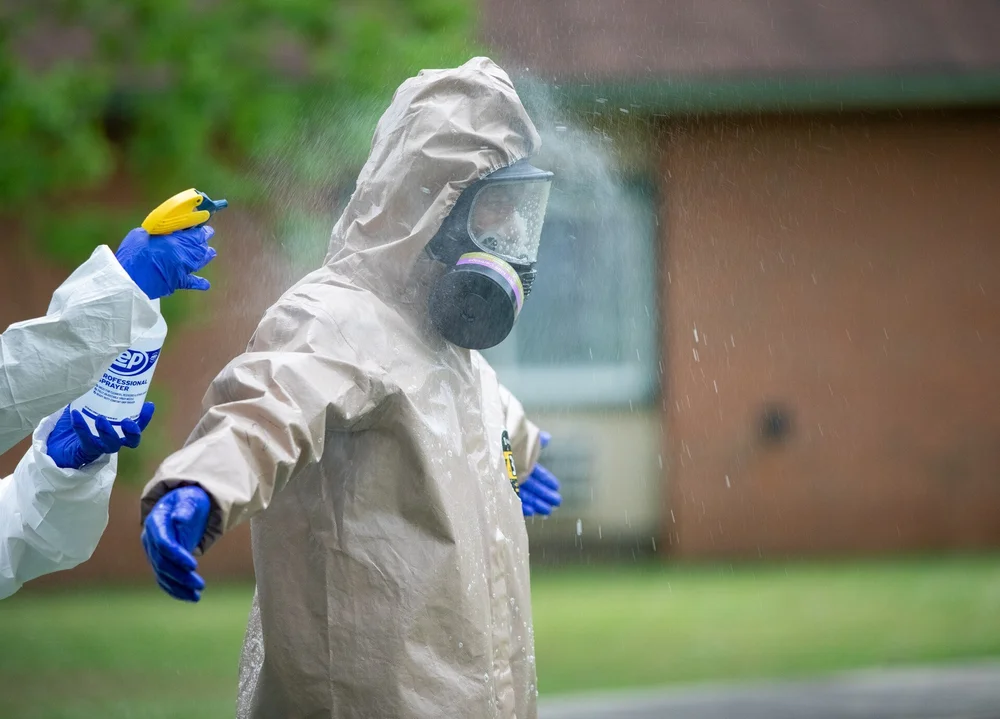
Photo: The National Guard, public domain, via Wikimedia Commons
The gap between release and recovery
Many people are surprised to learn that investigators do not clean. Police gather evidence, and the county medical examiner, who in Tennessee investigates sudden, unexpected and traumatic deaths, carries out their own inquiry. When both are done, the property is released. What remains is the owner's responsibility.
Post-incident remediation fills that gap. It applies after a death by suicide, a homicide, a serious injury or any traumatic event that has left biological material behind. It is the same work whether the property is a house, an apartment, a business or a vehicle, though the details change with the setting.
The five phases of remediation
| Phase | Purpose | What you receive |
|---|---|---|
| Assessment | Find every affected surface and material | A written scope |
| Removal | Take out what cannot be made safe | A list of removed items |
| Disinfection | Treat every surface that stays | Notes on areas treated |
| Odor control | Deal with odor at its source | A space that smells neutral |
| Handover | Return the space with records | Photos and an itemized invoice |
The sections below explain each one.
Assessment: seeing the whole picture
The assessment decides everything that follows. We look at the primary area and the paths people took through the property, check under and behind furniture, and identify every material involved, from sealed tile to carpet pad. We also note anything that affects how the job is done, such as stairs, shared walls, elevator access or HVAC returns.
The result is a written scope you can read before agreeing to anything. You can learn more in how a professional biohazard assessment works.
Removal and disinfection
Removal
Porous materials that have absorbed biological material, such as carpet, pad, mattresses, upholstery and sometimes sections of drywall or subfloor, are removed. They are packaged on site and disposed of in line with applicable Tennessee and federal requirements. TDEC treats medical waste as special waste, which generally cannot go to a landfill unless it has been treated to be non-infectious.
Disinfection
Every surface that stays is cleaned and then treated with EPA-registered disinfectants used according to label directions. Cleaning comes first because disinfectants work properly only on surfaces that have already been cleaned.
The guide biohazard cleanup versus standard restoration explains how this differs from water or fire restoration.
Odor control
Odor after a traumatic death is usually a sign that some source remains. Removing affected materials resolves most of it. What is left is addressed with deodorization of the air and surfaces. Fragrances only mask the problem, which is why we ask people not to use them before we arrive. If odor has reached ductwork or a structural element, we explain the options. Our guide to remediation and odor has more.
Handing the space back
The last phase is often the most important for the people involved. We walk through the property with the owner or their representative and explain what was done room by room. You receive:
- Before-and-after photos
- The written scope
- An itemized invoice listing materials removed and areas treated
- A note of anything a contractor should replace, such as drywall, flooring or paint
- Any personal items we set aside, cleaned where possible
These records can be given to an insurer, an estate executor, a landlord or a buyer as needed. Some property insurance policies may cover part of the work; that depends entirely on the policy and the insurer.
Who is involved during remediation
Remediation often involves more people than the owner expects. It helps to know who usually plays a part, so you can decide who speaks for you.
The person who authorizes the work
This is the owner, a family member with authority, an executor, a property manager or a business manager. They approve the scope and receive the records.
The insurer
If you intend to make a claim, contact your insurer early and tell them a cleanup company has been asked to assess the property. They may want to see the scope before work starts.
A contractor, later
If materials such as drywall or flooring are removed, a contractor rebuilds afterward. We tell you at the assessment if that will be needed, so you can line one up.
Family and neighbors
We do not discuss the work with anyone you have not named. If you want a relative or friend to be our point of contact, just tell us.
What owners can do while waiting
Between release and our arrival, keep people and pets out, close the door to the affected area, avoid running fans or HVAC toward it if that is easy, and do not throw anything away before you have spoken to your insurer. Please do not try to clean the area yourself. If the death occurred in Tennessee as the result of a crime, the state's Criminal Injuries Compensation program may, in some cases, help with cleaning costs in a victim's home; see our insurance questions guide and the official program page linked in our sources.
Which of our services this connects to
Remediation is the common thread across our work. Depending on what happened, you may also find these pages useful:
- Suicide scene cleanupOur full overview for families after a death by suicide.
- Crime scene cleanupAfter a homicide, assault or other crime.
- Unattended death cleanupWhen a death was discovered after some time.
- Traumatic incident cleanupSerious injuries and other traumatic events.
We travel from Nashville across Middle Tennessee, including Montgomery County and Robertson County; see all service areas.
Questions people ask
How will I know the property has been released?
Ask the investigating officer or the medical examiner's investigator directly. They will tell you when the scene is released. We confirm this before starting any work.
Is remediation the same as restoration?
No. Remediation removes biological contamination and makes the space safe. Restoration or rebuilding, such as new drywall, flooring and paint, is usually done afterward by a contractor.
Can the Tennessee crime victims program help with costs?
Usually not after a suicide, because the program covers crimes. Where a crime was involved, Tennessee Criminal Injuries Compensation may cover up to $3,000 for cleaning and removal of materials when the crime occurred in the victim's or an eligible relative's home. Repairs are not covered, the crime generally must be reported to law enforcement within 15 days, and claims must be filed within two years. The program is for victims of crime and is the payer of last resort, so it generally applies only where a crime was involved and other sources have been used first.
What documentation will I receive?
Before-and-after photos, the written scope and an itemized invoice. Tell us if an insurer, landlord or executor needs copies sent directly.
Can I place an order online instead of calling?
Yes. The Order Online page involves a $2,000 initial deposit. It is not the final price, and paying it does not fix a start time. We will still call to confirm access and arrange the assessment.
Sources
Ready for the next step
When the property has been released, call (615) 513-5112 and we will arrange the assessment and explain each phase as we go.

