Crime Scene Cleanup in Nashville, TN
When police finish their work and hand a property back, the cleanup becomes the owner's responsibility. Investigators collect evidence. They do not clean. That gap is what crime scene cleanup fills: removing blood and other biological material, taking out contaminated materials, and disinfecting the affected area so the space can be used again.
Nashville 24/7 Biohazard Disposals does this work from our base in Nashville, traveling to homes and businesses across Middle Tennessee. This page explains what the work covers, who usually calls, how a job is scoped and how to get started. The phone line at (615) 513-5112 is answered day and night.
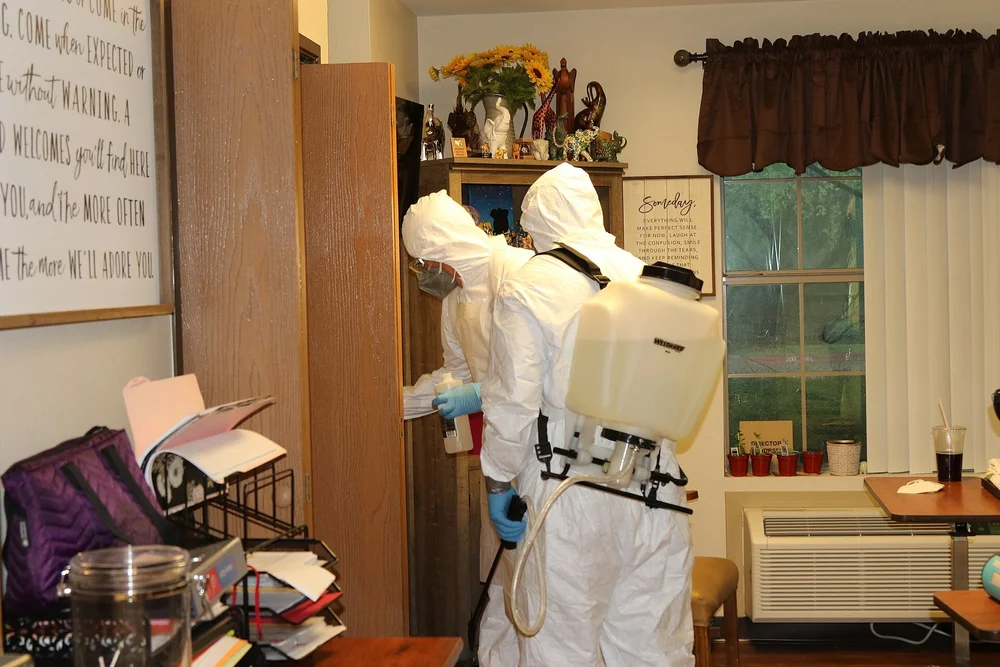
Photo: The National Guard, public domain, via Wikimedia Commons
What crime scene cleanup covers, and what it doesn't
Crime scene cleanup starts where the official investigation ends. The two are easy to confuse, so it helps to separate them.
What police and the medical examiner do
- Secure the scene and decide who can enter
- Photograph, measure and collect evidence
- Remove the person who died, if there was a death
- Release the property back to the owner or occupant when they are finished
What they generally leave behind
- Blood and other bodily fluids on floors, walls and furniture
- Contaminated carpet, pad and upholstered items
- Residue from evidence processing, such as fingerprint powder
- The job of disposing of biological waste correctly
Our work covers the second column. We remove visible and hidden biological material, take out porous items that can't be decontaminated, clean and disinfect the hard surfaces that remain using EPA-registered disinfectants according to label directions, and deodorize the affected area. Contaminated material is packaged and disposed of in line with applicable Tennessee and federal requirements.
What we don't do is rebuild. If drywall, subfloor or flooring has to come out, putting it back is usually a job for a general contractor. We will tell you plainly if your property will need one. This is very different from the cleaning a household or janitorial crew would do, mostly because of what is hidden under the surface and how the waste has to be handled.
Who usually calls us
The person who phones is rarely the person who expected to. Most callers have never needed this kind of service before. The people we hear from most often include:
- Family members who have been told by an officer or detective that the home is released and cleanup is up to them.
- Homeowners and tenants where a break-in, assault or other crime happened inside their own home.
- Landlords and property managers responsible for a unit where an incident took place, and who need a clear scope for the owner. Our page for property managers walks through that workflow.
- Business owners and store managers who need a sales floor, office, bar or stockroom made safe before staff come back. See commercial crime scene cleanup.
- Executors and relatives handling an estate who live out of town and need someone to coordinate access and report back.
You don't need to know the right terminology when you call. Describe what happened in whatever words you have, and we will ask the questions needed to understand the situation.
The types of crime scenes we clean
Every scene is different, but most fall into a few broad situations. Each of the pages below goes into one of them in more depth.
- Residential crime scene cleanupHouses, condos and townhomes where a family still lives or will return
- Commercial crime scene cleanupStores, offices, restaurants, bars and warehouses that need to reopen
- Homicide scene cleanupCareful, private work after investigators release the scene of a death
- Violent crime scene cleanupAssaults, robberies, stabbings and shootings where people survived
- Multi-room crime scene cleanupContamination carried through hallways, stairs and several rooms
- Crime scene blood cleanupFinding and removing blood that has soaked in or moved out of sight
- Crime scene cleanup for property managersOwner notices, tenant communication, keys and turnover
If a death was a suicide rather than a crime, our suicide scene cleanup pages are written for that situation. And if the incident was an accident or injury with no crime involved, see traumatic incident scene cleanup.
Police release, safety and keeping people out
If anyone is hurt or in danger, call 911 first. Nothing on this page comes before that.
Cleanup can't begin until law enforcement, and the medical examiner if there was a death, have released the property. In Tennessee, county medical examiners investigate sudden, unexpected, traumatic and suspicious deaths, so when a death is involved the ME's office is part of the process too. If you aren't sure whether the scene has been released, ask the detective or officer handling the case. We will ask the same thing when you call.
Why the area should stay closed off
Blood can carry bloodborne pathogens such as hepatitis B, hepatitis C and HIV, which the CDC notes can spread through contact with infected blood. That risk is the reason trained workers wear protective equipment for this work. Until the area has been cleaned, keep family members, children, pets and visitors out of it.
Employers whose workers have occupational exposure to blood fall under the OSHA Bloodborne Pathogens Standard, which requires an exposure control plan, protective equipment and training. That is one reason a business generally shouldn't hand this job to its regular staff.
What to do before we arrive
You don't need to prepare anything, and we'd ask you not to try cleaning the affected area yourself. A few simple, safe steps help:
- Close the door to the affected room if you can do so without going in.
- Keep people and pets away from the area.
- If it's easy to avoid, don't run fans or the HVAC system in a way that blows air from the affected area into the rest of the home.
- Don't throw away furniture, rugs or belongings until you have talked to your insurer, if you plan to make a claim.
- Write down the case or report number the officers gave you. You may need it for insurance or victim compensation.
The most common mistakes we see are well-meant: scrubbing carpet, which pushes material deeper into the pad, or pouring bleach on upholstery, which doesn't reach what has soaked in. Leaving it for us is the safer choice.
How the process works
The details change from job to job, but the order of work stays roughly the same.
You call
We ask what happened in general terms, whether the scene has been released, what kind of property it is, and how to reach the person who controls access. We confirm scheduling by phone. Distance from Nashville can affect timing.
Assessment
On site, we look at every affected surface and material, including the places blood tends to reach that aren't obvious at first glance, and agree a written scope with you before work begins.
Containment and removal
We set up the work area to keep contamination from spreading, then remove biological material and cut out porous materials that can't be saved.
Cleaning and disinfection
Hard surfaces are cleaned and then treated with EPA-registered disinfectants used according to label directions. The area is deodorized.
Waste and wrap-up
Contaminated material is packaged and disposed of in line with applicable Tennessee and federal requirements. You receive photos, the written scope and an itemized invoice for your records.
The guide to what crime scene cleanup involves explains each stage in more detail.
What the assessment looks at
The assessment is where the real size of the job becomes clear. Blood and fluids don't stay on the surface. They soak into carpet pad, wick up the back of drywall, run along baseboards and settle under furniture. A room can look nearly clean and still need materials removed.
During the walkthrough we look at:
- Which rooms and surfaces are affected, including areas people walked through afterward
- Whether materials are porous (carpet, pad, mattresses, upholstery, unsealed wood) or non-porous (tile, sealed counters, metal)
- Whether contamination has gone below the surface into subfloor or wall cavities
- Belongings in the area and what you'd like to keep
- Access: stairs, parking, building rules, keys and hours
Once we have seen everything, we explain what needs to come out, what can be cleaned in place, and why, before any work starts.
What affects scope, cost and insurance
We don't publish prices because two jobs that sound the same on the phone can be very different on site. Pricing is based on a written scope after the assessment. The main factors are:
| Factor | Why it matters |
|---|---|
| Extent of contamination | More affected area means more removal, cleaning and waste. |
| Materials involved | Carpet, pad, mattresses and drywall often have to come out; tile and metal usually can be cleaned. |
| Number of rooms | Each additional room or hallway adds containment and labor. |
| Access | Stairs, elevators, distance from parking and building rules all affect time. |
| Waste volume | Contaminated material has to be packaged and disposed of properly. |
Some property insurance policies may cover some of this work. Whether yours does depends entirely on the policy and the insurer, so call them and ask. We can give you photos, the written scope and an itemized invoice to send them. See how pricing works for more.
Tennessee victim compensation
If the crime happened in Tennessee in the victim's home or an eligible relative's home, the state's Criminal Injuries Compensation program can pay up to $3,000 for cleaning and removal of materials. Repairs and replacement aren't covered. The crime generally must be reported to law enforcement within 15 days, though exceptions exist, and the claim must be filed within two years. The program pays last, after other sources such as insurance. The Tennessee Treasury runs the program and decides every claim.
If you want to get on the schedule online, the Order Online page takes a $2,000 initial deposit. That isn't the final price, and it doesn't mean work starts within a particular time.
Where we work
We are one team based in Nashville, and we travel out to properties across Middle Tennessee: Davidson, Rutherford, Williamson, Montgomery, Sumner, Wilson, Maury, Robertson, Dickson, Cheatham, Macon, Hickman, Smith, Cannon and Trousdale counties. We don't have offices in other towns. Scheduling for every location is confirmed by phone, and distance can affect timing.
Many of our calls come from inside Nashville, and we also regularly travel to places like Murfreesboro, Franklin and Clarksville. The full list is on our service areas page.
Questions people ask
Do the police clean up after a crime?
No. Police and the medical examiner document the scene and collect evidence, then release the property. Cleaning up blood and other biological material is left to the property owner or occupant, who can hire a cleanup company to do it.
How do I know the scene has been released?
Ask the officer or detective assigned to the case. They will tell you when you can go back in and whether any areas are still off limits. We won't begin work until the property has been released.
Can I stay in the house while you work?
Often yes, if the affected area is separate from where you'd be. We contain the work area, and we will talk with you about which rooms to avoid. For larger jobs, some families prefer to stay with relatives until we finish.
Who pays for crime scene cleanup in Tennessee?
Usually the property owner, sometimes with help from a property insurance policy, depending on the policy. If the crime happened in the victim's home in Tennessee, the state Criminal Injuries Compensation program may cover up to $3,000 of cleaning and removal costs.
Will you remove belongings from the affected room?
We remove items that are contaminated and can't be cleaned, and we talk with you first about anything with personal value. Items that can be cleaned are kept. If you plan to make an insurance claim, we photograph what's removed.
Do you come out to towns outside Nashville?
Yes. We travel from Nashville to the fifteen Middle Tennessee counties on our service areas page. Call us to confirm scheduling for your location.
Sources
- Tennessee Criminal Injuries Compensation, Tennessee Department of Treasury
- Tennessee Medical Examiner System pamphlet, Office of the State Chief Medical Examiner
- OSHA Bloodborne Pathogens Standard (29 CFR 1910.1030)
- CDC/NIOSH: Bloodborne infectious diseases
- EPA: Selected EPA-registered disinfectants
- TDEC special waste guidance (medical waste)
Talk to someone about your property
Call (615) 513-5112 at any hour. Tell us what happened in your own words, and we'll explain the next steps and confirm scheduling for your location.

