Advanced Decomposition Cleanup
Advanced decomposition cleanup is needed when a long interval has passed and biological material has gone beyond furniture and flooring into the structure of the home: subfloor, drywall, framing and sometimes the ceiling below. It is more involved than a typical case, and it usually ends with a contractor doing repairs.
This page is for families and owners facing that situation. It explains what structural removal involves, how we work alongside a contractor, how insects are handled, and how to think about time and cost.
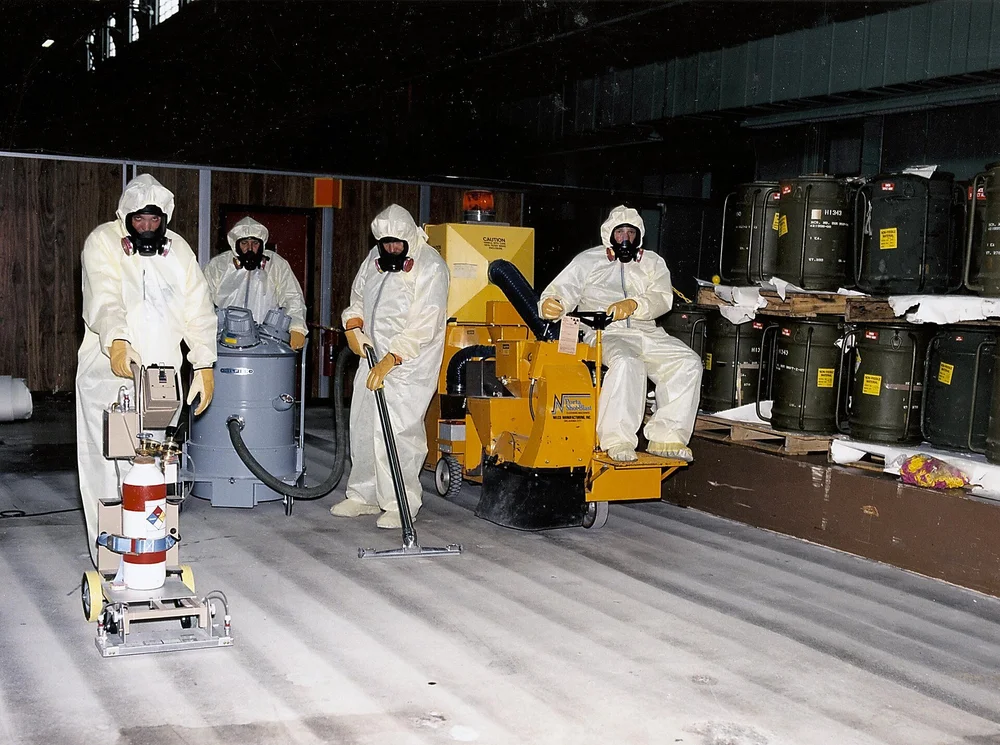
Photo: U.S. Department of Energy, public domain, via Wikimedia Commons
What makes a case advanced
There is no fixed number of days. A case becomes advanced when the volume of material and the time it has had to spread mean that removing furnishings and floor coverings is not enough. Signs we look for include fluid that has passed through the subfloor, staining on the ceiling of a room below, material that has entered a wall cavity at floor level, and odor that has moved into other rooms or the ductwork.
Heat plays a part. A closed house in a Tennessee summer, with the air conditioning off, will reach this stage faster than a cool house in winter.
When structural materials have to come out
Building materials are judged on whether they can be cleaned to a sound condition. Some can, many cannot.
| Material | What usually happens |
|---|---|
| Plywood or OSB subfloor | Stained but sound sections may be cleaned and sealed. Saturated sections are cut out to the nearest joists. |
| Floor joists | Solid lumber is often cleaned, disinfected and sealed. Replacement is a structural decision for a contractor. |
| Drywall | Affected lower sections are cut out, usually in a straight line above the highest point of contamination. |
| Baseboards and trim | Usually removed with the drywall and disposed of. |
| Ceiling below (upper floors) | Stained drywall or tiles are removed and the framing above checked. |
| Insulation in the cavity | Removed if it is in contact with affected material. |
Our guide How Professionals Determine Whether Materials Can Be Remediated explains the reasoning behind each decision.
Working alongside a contractor for repairs
We clean, remove and disinfect. We do not rebuild. Once our work is done, the room will be clean but missing some floor, wall or ceiling, and a general contractor or flooring installer will handle the repairs.
To make that handoff easy:
- We tell you during the assessment if your project will need a contractor afterward, so it is not a surprise.
- The written scope and photos show exactly what was removed and where, which helps the contractor quote accurately.
- Openings are left clean and, where appropriate, sealed, so the contractor is working in a clean space.
- We can talk to your contractor or adjuster directly if you want us to.
The difference between the two kinds of work is covered in Biohazard Cleanup Versus Standard Restoration.
Insects and pests
In long-interval cases, insects are common. This is a normal part of the natural process and not a sign that anything was neglected. Flies and their larvae are the usual ones. They are drawn to the area and can spread to window sills and nearby rooms.
Insects are dealt with as part of the cleanup: removed with the contaminated material, with the surfaces where they collected cleaned and disinfected. If there is ongoing activity elsewhere in the home after our work, a pest control company may be worth calling.
How the work is staged
Assess the structure
We check above, below and beside the affected area, including crawl spaces, rooms below and wall cavities, before setting the scope.
Contain the area
Plastic sheeting and controlled entry keep dust and material in the work zone, and air handling to that area is closed off where possible.
Remove contents and coverings
Furniture, flooring and soft items come out first, so the structure underneath can be seen clearly.
Cut out affected structure
Subfloor, drywall, trim and insulation in contact with material are cut out cleanly and bagged.
Clean, disinfect and seal
Remaining framing and surfaces are cleaned and treated with EPA-registered disinfectants used according to label directions, then sealed where appropriate.
Deodorize and hand over
After the source is gone, odor treatment follows. You receive photos, the final scope and an itemized invoice for your records.
Safety and access before work begins
Cleanup only starts once police and the medical examiner have released the property. After that, the priority is keeping people out of the affected area. In advanced cases the floor itself may be weakened where material has soaked in for a long time, so please do not walk on soft or stained flooring near the area, and keep children and pets well away.
If the home has been closed up, resist the urge to open every window and run fans. Pushing air through the house can carry odor into rooms that were not affected. Close the door to the room, switch off the air handler if that is easy, and leave the rest to us. The guide How Cleanup Teams Manage Access and Containment explains how we keep the rest of the home protected once work begins.
How long it takes and what affects cost
Advanced cases take longer than a typical bedroom cleanup, often several days of work on site, sometimes more if multiple rooms or levels are affected. We give you a realistic estimate after the assessment and update you if we find something unexpected once materials are opened up.
Cost depends on the amount of structure removed, the number of rooms, access (a second-floor bedroom over a finished living room is very different from a slab-on-grade ranch) and disposal volume. We do not publish prices; the written scope sets them. Some property insurance policies may cover some of this work, depending on the policy. The guide How to Evaluate a Biohazard Cleanup Quote can help you compare scopes.
Questions people ask
Will the floor joists have to be replaced?
Often not. Solid lumber can usually be cleaned, disinfected and sealed. Whether a joist needs replacing for structural reasons is a decision for a contractor, and we will point out anything that looks like it needs their opinion.
Do you rebuild the floor or walls afterward?
No. We remove, clean and disinfect. Repairs such as new subfloor, drywall and flooring are a contractor's job. We tell you early if your project will need one and provide the documentation they will want.
The room below has a stain on the ceiling. Is that part of this job?
Yes. If material has reached the ceiling below, that area is included in the scope. We check it during the assessment and remove affected ceiling materials as needed.
Can I sell the house after this kind of cleanup?
Many people do, once repairs are complete. Tennessee law (T.C.A. § 66-5-207) says no cause of action arises against an owner or real estate licensee for not disclosing that a property was the site of certain deaths, but that is general information, not legal advice. Talk to an attorney or your real estate agent about your situation.
What if more contamination is found once the floor is opened?
It happens sometimes. We stop, show you or your representative what we found with photos, and agree any change to the scope before continuing.
Sources
Get a clear picture of the structure
Call (615) 513-5112 to arrange an assessment. We will tell you what needs to come out and whether a contractor will be needed afterward.