How to Prepare a Property for Professional Remediation
Preparing a property for biohazard remediation is about logistics, not cleaning. You make sure the crew can get in, has power and water, has somewhere to park and knows what matters to you. You do not touch, move or clean anything in the affected area. That part belongs to the professionals.
This guide lists the practical things owners, families and managers can do in the hours or days before the crew arrives, along with the information that makes the first conversation faster.
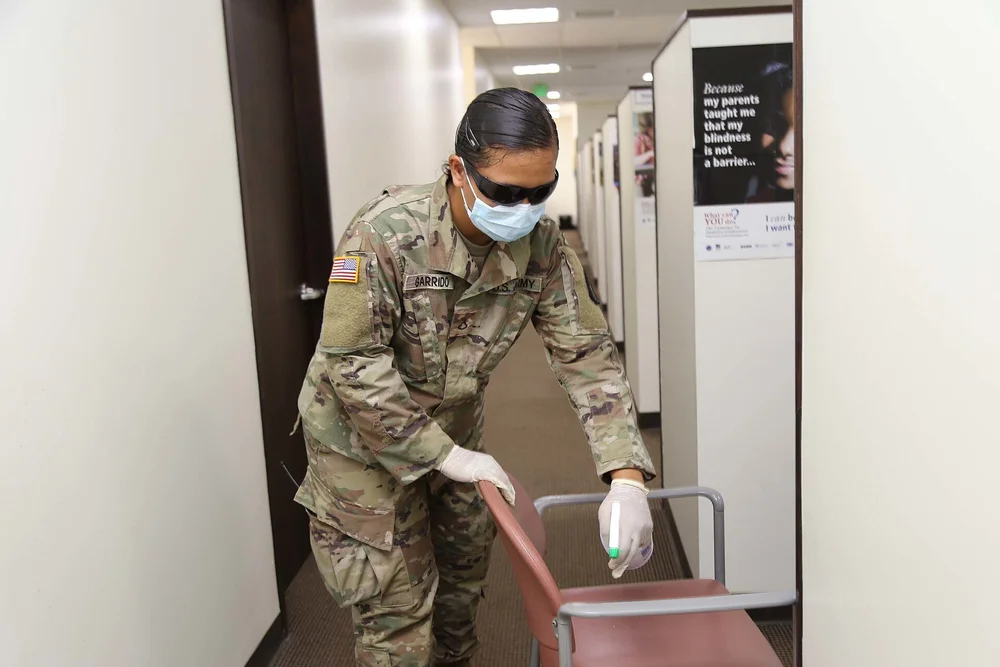
Photo: The National Guard, public domain, via Wikimedia Commons
The one rule that comes before everything else
Everything on this page assumes the affected area stays exactly as it is. Leave the room, close the door if you can, and keep it closed. That single decision protects you, keeps contamination from spreading and gives the crew an accurate picture of the job.
Hands off the affected area
Do not wipe, pick up, move or bag anything that may have blood or bodily fluids on it, even something small. Contact with infected blood can spread bloodborne pathogens such as hepatitis B, hepatitis C and HIV, according to the CDC. If you have already had contact, wash with soap and water and talk to a medical provider.
If you are unsure where the affected area ends, assume it is larger rather than smaller. A hallway, a bathroom next to a bedroom or a stair landing can all be involved. The professional biohazard assessment will define the boundaries. For the full list of things to avoid, read what not to do before an assessment.
Confirm the property is released
If police or the medical examiner were involved, ask whether the property has been released before you plan anything else. Remediation cannot start while a scene is under investigation. Write down the agency name and any report number you are given, because an insurer may ask for it later.
Sometimes a release comes in stages. A house might be released while a vehicle in the driveway is still held, or a bedroom might be released after the rest of the home. Tell the cleanup company what has been released and what has not.
If you are not sure whom to ask, the agency that responded can usually tell you. For deaths, the county medical examiner's office handling the case is the right contact; Tennessee's Office of the State Chief Medical Examiner explains that county medical examiners investigate sudden, unexpected and traumatic deaths. Once you have confirmation, note the date and time you were told.
Access, keys and alarm codes
Crews lose more time to locked doors than to anything else. Sort out access before the scheduled visit.
- Decide who will meet the crew, or whether a lockbox or key handoff will work instead.
- Gather every key the crew may need: front door, back door, garage, storage room, mailbox if relevant.
- Write down the alarm code, or arrange for the alarm to be off during the work. Tell the monitoring company to expect workers.
- If the property is in a gated community or a secured building, arrange a gate code, a visitor pass or a call ahead to the front desk.
- For a condo or managed building, tell the association or manager that a contractor is coming, and ask about elevator reservations or loading door rules.
- If a lock was damaged during entry, have it repaired or replaced from the outside before the visit.
Our guide on how property access affects a cleanup project explains why stairs, narrow halls and distance from parking can change the plan.
Utilities the crew will need
Remediation depends on electricity for lighting, air filtration and other equipment, and on running water. If the property has been vacant, or if utilities were shut off after a death, check them now.
| Utility | What to check | Why it matters |
|---|---|---|
| Electricity | Service is on and the breaker panel is accessible | Lights and equipment need power on site |
| Water | Service is on; you know where the main shut-off is | Needed for cleaning, and the crew should know how to stop a leak |
| Heating and cooling | Thermostat location; whether the system serves the affected room | The crew may want the system off or adjusted during work |
| Gas | Whether there is gas service and where the meter is | Useful if appliances must be disconnected or moved |
If service has been disconnected, call the utility as soon as you can, since reconnection may take time. In a rental or an estate property, the account holder may have changed, so ask the landlord or the person handling the estate who should make the call.
As for heating and cooling: if it is easy to switch off a system that blows air through the affected room, do so. If it would mean entering the room or the system also heats the rest of an occupied home in winter, leave it and mention it when you call.
People, pets and the household routine
If anyone is living in the property, plan where they will be during the work. Most households keep using unaffected parts of a home while a crew works in a sealed-off area, but some prefer to stay with friends or relatives for a day or two, especially if the affected room is near bedrooms or the kitchen.
Children
Keep children out of the affected area entirely, and consider having them elsewhere while the crew works. Workers in protective suits and respirators can be frightening to a young child.
Pets
Pets walk through things, lick their paws and carry material from room to room. Keep them out of the affected area now. On the day of the work, crate them in a far room, board them or leave them with someone you trust. Tell the crew about any pet that might slip out of an open door.
Medications and daily needs
If medications, a wheelchair, oxygen equipment or other daily necessities are in or near the affected room, tell the crew. They can help retrieve unaffected items safely, rather than you walking in to get them.
Someone with a health condition in the home
If anyone in the household has a weakened immune system, a breathing condition or is pregnant, mention it when you call. The crew can plan containment and timing with that in mind, and you may decide it is simpler for that person to stay elsewhere until the work is done.
Your own wellbeing
Preparing a property after a traumatic event is draining, even when the tasks are practical. Ask friends or relatives to take on errands such as collecting keys or calling the utility. You do not have to coordinate every detail alone.
Make a list of what matters to you
The single most helpful thing you can give the crew, apart from access, is a short list of items that matter. It does not need to be long or organized. A note on your phone is enough.
- Irreplaceable items: photographs, letters, a family Bible, a quilt, military medals, a child's artwork.
- Valuables: jewelry, cash, coins, firearms, safes and their locations if known.
- Documents: wills, deeds, titles, insurance policies, passports, tax papers, checkbooks.
- Electronics with data: phones, laptops, external drives, cameras.
- Items you know are in the affected area that you would like the crew to look at closely before any decision.
You do not need to retrieve any of these yourself. The crew uses the list to watch for them. If an item is in the affected area, the crew will tell you what condition it is in and whether it can be cleaned. Our guide on how professionals decide whether materials can be remediated explains how those calls are made, and the contaminated furniture and material assessment page covers larger pieces.
Parking, the driveway and the neighbors
Crews arrive with a work vehicle and equipment, and they will carry sealed containers of waste out of the property. A clear, short path from the door to the vehicle makes the work faster and keeps it discreet.
- Move cars out of the driveway or reserve a space close to the door.
- In a neighborhood with an HOA, check whether work vehicles need a pass or have parking limits.
- On a rural property with a long or gravel drive, describe it when you call, and mention gates, soft ground or a low-hanging branch.
- In an apartment or condo, ask the manager which entrance and elevator the crew should use.
You do not owe neighbors an explanation. If you want to say something, We have some contractors working inside for a few days is enough. Crews do not discuss clients with neighbors.
Information to have ready when you call
You do not need all of this to make the first call, but having it nearby makes the conversation quicker and the scope more accurate.
The address and property type
House, apartment, condo, business, vehicle; number of stories; how the affected area is reached.
What happened, in general terms
For example, an injury, an unattended death, a crime. You do not need to describe anything graphic.
Which rooms or areas may be affected
A rough guess is fine, including surfaces such as carpet, hardwood, tile or upholstered furniture.
Whether the property is released
And the agency's name and report number, if you have them.
Who owns the property and who is authorizing the work
Owner, landlord, manager, executor or family member.
Insurance details
The insurer's name, the policy number and a claim number if you have opened a claim.
Our guide to communicating with a cleanup company has more on what to ask and how to describe a situation without having to relive it.
A quick word with the insurer before the crew arrives
If the property is insured, call the insurer or your agent before contaminated materials are removed. Ask whether they want an adjuster to see the property first, whether photographs taken by the cleanup crew are enough, and what documents they need afterward. Some property insurance policies may cover some of this work; coverage depends on the policy and the insurer.
We provide documentation you can give your insurer: photographs, a written scope and an itemized invoice. The guide to insurance questions after a biohazard incident lists questions worth asking. For costs, see how pricing works. If you decide to book online, the Order Online page takes a $2,000 initial deposit, which is not the final price and does not set a start time.
Write down the name of everyone you speak with at the insurer, the date and what they told you. If they ask you to keep damaged items for inspection, tell the cleanup company before the visit so the crew can document and hold them rather than removing them straight away.
On the day of the work
Here is what usually happens once the crew arrives, so nothing feels unexpected:
- The crew walks the property with whoever let them in, confirms the affected areas and reviews your list of important items.
- They set up containment around the work area, often with plastic sheeting and controlled entry points. See how cleanup teams manage access and containment.
- You may hear air filtration equipment and see workers in protective gear moving sealed containers to the vehicle.
- You do not need to stay. Many people leave once the crew is set up and come back when called.
- When the work is complete, the crew walks you through what was done and what, if anything, a contractor will need to rebuild.
To understand what the crew is wearing and why, read professional cleanup equipment and PPE.
Notes for businesses, rentals and vehicles
Businesses
Decide whether you will close the affected part of the building or the whole site during the work, and tell employees which entrances to use. Have someone with authority reachable by phone. The workplace biohazard cleanup page covers commercial jobs.
Rentals
If you are the landlord, confirm who has the right to possession before scheduling, and give the tenant or the tenant's family notice of the visit. Owners can find more in our landlord and property-manager guides.
Vehicles
Leave the vehicle where it is if it is in a safe place, and tell us where it is parked and where the keys are. If it was towed, give us the tow yard's details. See vehicle biohazard cleanup.
If the property has been empty for a while
Remediation often happens in homes that have been closed up since an incident, sometimes for weeks while an estate is sorted out. A vacant property brings its own small list of things to arrange, none of which involve going into the affected area.
- Mail and packages. Ask a neighbor to collect them or arrange mail forwarding through the post office, so the home does not look abandoned.
- Lawn and exterior. An overgrown yard or a full porch draws attention. Ordinary yard care is fine and can be done at any time.
- Appliances. Leave refrigerators and freezers closed. If power was off for a long time, mention it when you call, since spoiled food is something the crew may need to plan for.
- Insurance on an empty home. Some policies have terms about vacant or unoccupied homes. Ask the agent how the policy treats the property while it is empty, and keep it in force.
- Security. Check that doors and windows are locked from the outside, and consider timers on lights in unaffected rooms if someone can set them without entering the affected area.
If the person who died owned the home, the estate property cleanup page describes how we work with executors and families on properties like these.
Your readiness checklist in brief
A property is ready for professional remediation when the scene is released, the affected area is closed and untouched, the crew can get in, power and water are on, people and pets are elsewhere or out of the way, and you have a short list of what matters to you. Everything else can be worked out on the phone.
Nashville 24/7 Biohazard Disposals is one team based in Nashville that travels to properties across Middle Tennessee, from Franklin to Lebanon. Scheduling for each address is confirmed by phone at (615) 513-5112.
Questions people ask
Should I clear a path by moving furniture out of the way?
Only furniture outside the affected area, and only if it is easy and safe. Leave anything in or next to the affected room where it is. The crew will move it if needed.
Do I need to be there when the crew arrives?
Someone needs to let them in and confirm the plan, but it does not have to be you. A relative, a manager or a trusted neighbor can do it, or a lockbox can work if the owner agrees.
The power has been shut off at a relative's empty house. Can work still happen?
Tell us when you call. Power is needed for the work, so the account may need to be reconnected first. In some cases a crew can bring limited power, but that depends on the job.
Should I take photos before the crew arrives?
If you can do so from a doorway without entering the affected area, a few photos can help your insurer. Do not go in to get closer shots. The crew also documents the property before and after the work.
Is it all right to open windows?
Opening a window in another room for fresh air is usually fine. Avoid going into the affected room to open windows, and avoid setting up fans that blow air out of that room into the rest of the house.
What should I tell the HOA or building manager?
Only what they need: a contractor will be working inside on certain dates, which entrance they will use and where they will park. You do not need to explain why.
Can I put my own trash out with the crew's waste?
No. Contaminated material is packaged separately and disposed of in line with applicable Tennessee and federal requirements. Household trash should go out through your normal collection, and nothing from the affected area should go into it.
How much notice does the crew need before the visit?
None to take your call; the phone is answered at any hour. The visit itself is scheduled by phone, and distance from Nashville can affect timing. Having access, utilities and parking sorted before that call lets us plan with fewer unknowns.
Should I cancel the home's utilities or insurance after a death?
Not before the work is done. The crew needs power and water, and the insurer may be part of paying for the cleanup. Talk to the person handling the estate before closing any accounts.
Should I buy plastic sheeting and tape to seal the room myself?
No need. Closing the door is enough. The crew brings and sets up its own containment, and taping plastic around an affected doorway can mean handling surfaces you should not touch.
Sources
Tell us about the property
Call (615) 513-5112 at any hour with the address and what you know so far. We will tell you what the crew needs and set up an assessment.