What Not to Do Before a Biohazard Cleanup Assessment
Before a biohazard cleanup assessment, the most helpful thing you can do is very little. Don't scrub, don't pour bleach on carpet or furniture, don't throw anything away, and don't run fans or air systems through the affected room. Each of those reasonable-seeming steps can spread contamination, hide the extent of the problem or cost you an insurance claim.
Below, each mistake is explained with the reason behind it, so you can make good decisions in the hours before the visit.
If you or someone close to you is struggling after what happened, the 988 Suicide & Crisis Lifeline is available by call or text at 988.
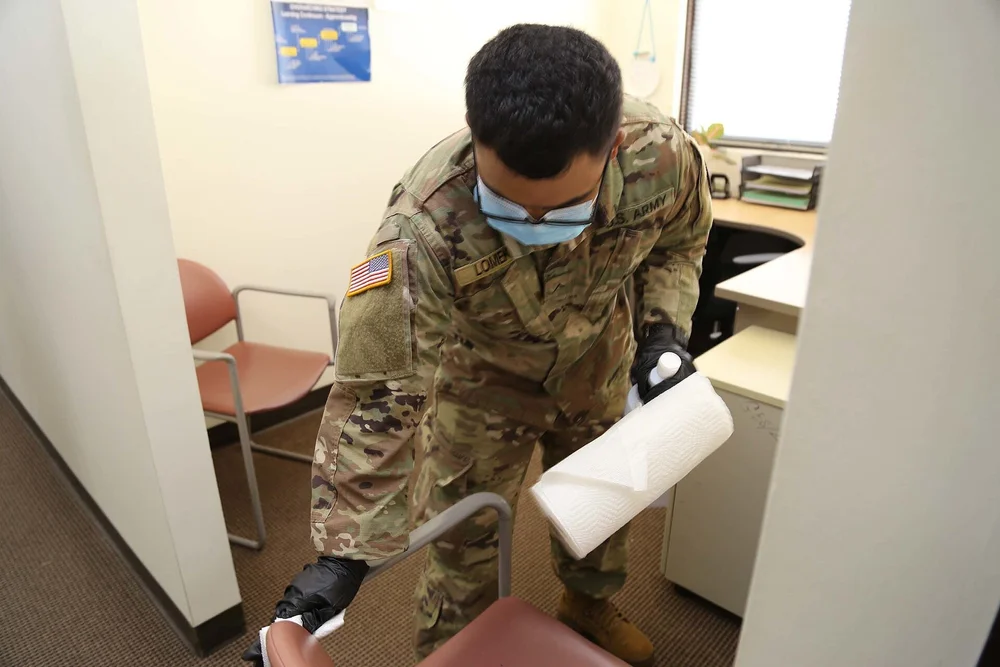
Photo: The National Guard, public domain, via Wikimedia Commons
Why doing less helps the assessment
An assessment is a careful look at what is affected: which surfaces, which materials, how far the contamination reaches and what can be cleaned versus what has to be removed. Our guide to how professionals assess rooms and materials describes that process. The assessor reads the scene as it is. When someone has already wiped, sprayed, moved or discarded things, three problems follow.
- The contamination may have spread. Wet cleaning carries material into seams, under baseboards and into the pad beneath carpet. Footsteps and tools carry it to other rooms.
- The visible picture no longer matches the real one. A surface that looks clean may still be contaminated underneath, which makes the scope harder to judge.
- The record is weaker. Insurers and, sometimes, investigators want to know the original condition.
None of this is about blame. Most people who start cleaning are trying to protect someone else from seeing it. The rest of this page explains the specific actions to hold off on.
Don't scrub, mop or wipe the affected area
Scrubbing is the most common instinct and the one that causes the most trouble. Blood and other bodily fluids are not just surface stains. On carpet they soak into the pad and sometimes the subfloor. On hardwood they follow the joints between boards. On drywall they wick into the paper face. Scrubbing pushes material deeper and spreads it sideways, so an area that needed one section of flooring removed can turn into a larger job.
There is also the health side. The CDC notes that bloodborne pathogens such as hepatitis B, hepatitis C and HIV can be spread through contact with infected blood. Professional crews work under the precautions set out in OSHA's Bloodborne Pathogens Standard, with protective equipment and procedures that household gloves and a sponge cannot replace.
A very small spill on a hard surface is different
A few drops from a nosebleed on a tile floor are a household matter that public-health guidance covers. Professional help is for anything larger, on porous material, hidden under or behind things, or emotionally hard to face. Our guide on the limits of household cleaning helps you tell the difference.
Don't pour household bleach on carpet, fabric or wood
Bleach feels like the strongest option in the cupboard, so people reach for it. On porous materials it creates new problems without solving the original one.
- It does not reach where the contamination is. On carpet and upholstery, fluids have usually moved into the backing, pad or cushion. Bleach poured onto the surface mostly stays at the surface.
- It adds liquid. More liquid carries contamination further into the material and the floor beneath.
- It damages surfaces. Bleach discolors carpet, fabric and finished wood, which can make it harder for an assessor and an insurer to see the original condition.
- It can produce dangerous fumes. The CDC's guidance on using bleach after an emergency says never to mix bleach with ammonia or any other cleaner. In a stressful moment, it is easy to spray one product over another.
Professional crews use EPA-registered disinfectants according to label directions, chosen for the surface and the situation, and only after contaminated porous materials have been removed. Our guide on what happens to contaminated porous materials explains why removal, not disinfection, is usually the answer for carpet and mattresses.
Don't throw anything away yet
The urge to get rid of a stained mattress, rug or chair as quickly as possible is very human. Hold off for three reasons.
Your insurer may need to see it
If you plan to make a claim, the insurer may want to inspect damaged items or at least see clear photographs before they leave the property. Ask your insurer before you discard anything. Removed items cannot be shown again.
It may not be safe to put in the trash
Medical waste is classed as a special waste under Tennessee rules, and TDEC guidance says it generally cannot go to a landfill unless it has been treated to be non-infectious. A contaminated mattress dragged to the curb also exposes sanitation workers, neighbors and children. Professionals package contaminated material and dispose of it in line with applicable Tennessee and federal requirements.
Some items might be saved
Hard objects and some keepsakes in the affected area can often be cleaned. Once something is in a dumpster, that choice is gone. The guide on how professionals decide whether materials can be remediated explains how those decisions are made.
Including the things that look ruined
People sometimes assume a damaged item has no value to an insurer because it obviously cannot be kept. The opposite is often true: that item is the evidence of the loss. Its presence in the scope and photographs is what lets an adjuster understand the claim. Let it leave the property with the cleanup crew, documented, rather than with the household trash.
Don't run fans, the HVAC or an ozone machine through the room
When there is an odor, people open everything up and start moving air. Pulling air out of the affected room and through the rest of the building moves odor and fine particles into spaces that were not affected. Central systems can carry them into ductwork that serves every room.
- If it is easy to switch off a system that serves the affected room without going into it, do so.
- Don't set up box fans in the doorway or window of the affected room.
- Don't rent or run an ozone generator. EPA warns that ozone can damage the lungs and that, at concentrations that do not exceed public health standards, it has little potential to remove indoor air contaminants. It can also exceed health standards even when used according to instructions.
- Opening a window in a different, unaffected room for fresh air is fine.
Odor is treated at its source by removing the materials that hold it and cleaning what remains. See biohazard remediation and odor concerns and odor-related biohazard remediation.
Candles, incense and heaters
Scented candles and incense are another way people try to cope with odor. They add smoke and residue to the air, and an open flame in a stressful, distracted household is a fire risk. Space heaters pointed into a cold affected room can speed up odor as well. It is better to keep the room closed and, if the smell makes the home hard to live in, stay elsewhere for a short time.
Don't cover it up with paint, air fresheners or new flooring
Some property owners, under pressure to re-rent or sell, try to hide the problem. Sprays and plug-in fresheners mask odor for a short while and then mix with it. Paint over a stained wall can seal contamination behind a fresh surface where it may later bleed through or keep producing odor. New carpet laid over an affected subfloor traps the problem under an expensive layer that will have to come up again.
Covering a problem also makes it harder to talk about honestly with a buyer, tenant or insurer later. A remediated room with records is a much stronger position than a painted-over one. Owners can read more in what property owners should know after a crime scene.
Don't go in before the scene is released, or bring others in after
If police or the county medical examiner were involved, the property is theirs until they release it. Entering early can disturb an investigation. After release, it is still wise to limit who goes in. Every extra person, especially children and pets, is another chance for contamination to be carried around the building and another person who sees something hard to forget.
Be particularly careful with well-meaning helpers: a church group, a friend with a carpet cleaner, a handyman. Thank them, and ask them to help in other ways, such as meals, childcare or phone calls. The guide on crime scene cleanup versus general cleaning explains why ordinary cleaning services are not equipped for this.
Children and teenagers need extra care
Young people are often curious, and a teenager may want to help in a practical way. Keep them away from the affected area entirely, and give them something real to do elsewhere, such as looking after a pet or a younger sibling. If they have already seen the room, talk with them calmly about it, and consider asking a pediatrician or school counselor for advice on support.
Don't rent a carpet cleaner or wet vacuum
Rental carpet cleaners and shop vacuums look like the professional solution, and that is exactly the problem. Extraction machines spray liquid into carpet and pull some back out, which spreads material through the pad and leaves the rest in the machine's tank and hoses. The machine then goes back to the rental store. A shop vacuum on a dried area can put fine particles into the air and into its own filter.
Even in professional hands, carpet and pad that have absorbed bodily fluids are normally removed rather than cleaned. Our page on blood in carpet and subfloor explains how that work is done.
Don't delay the insurer, or wait on them for everything
Two opposite mistakes happen with insurance. Some people do nothing until an adjuster visits, which can take time while the room sits. Others never call the insurer at all and later find their claim is harder to support.
The middle path works better. Call your insurer early, tell them what happened in general terms, and ask whether they want to inspect before anything is removed or whether photographs and professional documentation are enough. Some property insurance policies may cover some of this work; coverage depends entirely on the policy and the insurer. We provide photographs, a written scope and an itemized invoice that you can give your insurer. The guide to insurance questions after a biohazard incident lists what to ask.
If the incident was a crime in your home, Tennessee's Criminal Injuries Compensation program can pay up to $3,000 for cleaning and removal of materials, as the payer of last resort. The crime generally has to be reported to law enforcement within 15 days, and claims must be filed within two years.
Don't agree to work without a written scope
Under stress, it is tempting to say yes to the first person who sounds sure of themselves. Before any company starts, ask for a written scope that lists the areas and materials involved and what will be removed. Ask how the price is calculated and what might change it. A good company will answer plainly and will not pressure you.
Our guides to evaluating a biohazard cleanup quote and questions to ask a cleanup company walk through this, and our pricing page explains how we price from a written scope. If you choose to book through our online order form, it takes a $2,000 initial deposit, which is not the final price and does not set a start time.
It is also fine to say you need an hour to think, or to talk to a family member or your insurer, before approving a scope. A cleanup company that respects you will wait, while the affected room stays closed and nothing gets worse in that hour.
What you can safely do instead
After a page of things to avoid, here is the short list of safe, helpful actions:
- Call 911 first if anyone is hurt or in danger.
- Keep people and pets away from the affected area and close the door.
- Switch off air systems serving the room if that is easy to do without entering.
- Take photos from the doorway if you can do it without stepping in.
- Call your insurer and write down the claim number.
- Keep damaged items in place until your insurer and the cleanup company have seen them.
- Make a short list of important belongings for the crew.
- Call a professional cleanup company to arrange an assessment.
For the logistics side, such as keys, utilities and parking, see how to prepare a property for professional remediation.
Don't make big property decisions before you know the scope
When something terrible has happened in a home, it is common to want to make a large decision right away: gut the room, sell the house, break the lease, hire a renovation contractor. Those choices may turn out to be right, but they are easier to make well once you know what is actually affected.
An assessment tells you which materials are involved, whether the subfloor or drywall is affected and whether a contractor will be needed afterward. With that in hand, you can compare renovation quotes against a real scope, give an insurer accurate information and decide about the property with clear facts instead of the first shock.
Reasonable now
- Notifying the insurer and opening a claim
- Arranging a professional assessment
- Finding somewhere else to stay for a few nights
- Asking an attorney about lease or estate questions
Better after the assessment
- Signing with a demolition or renovation contractor
- Listing the property for sale or rent
- Replacing flooring or repainting
- Letting the property insurance lapse
Tennessee has a statute, Tenn. Code Ann. § 66-5-207, about not disclosing that a property was the site of a homicide, felony or suicide. If you are thinking about selling or renting, ask an attorney how it applies before you decide anything.
Holding steady until the assessment
The hours before an assessment are when well-meant actions do the most harm. Leaving the affected area alone, keeping air systems from moving air through it, holding on to damaged items and calling your insurer early will keep your options open and the job as contained as possible. You do not have to fix anything yourself.
Nashville 24/7 Biohazard Disposals takes calls at any hour at (615) 513-5112 and travels from Nashville to homes and businesses across our Middle Tennessee service area. You can also send us a message.
Questions people ask
I already scrubbed part of the carpet. Have I made things worse?
Possibly a little, but it is not a disaster, and you are far from the first person to do it. Stop, wash your hands well with soap and water, and tell the assessor what you did and where. It helps them judge how far material may have spread.
Is it all right to use a disinfectant spray from the store on the edges?
It is better not to. Spraying adds moisture, can mix with other products and changes what the assessor sees. Leave the area as it is and let the crew choose the right EPA-registered product for the surface after removal.
Can I put the stained bedding in the washing machine?
Not if it has bodily fluids from a traumatic event on it. The washer can be contaminated and the items may not come clean. Leave the bedding where it is for the assessment.
The smell is affecting the whole house. Can I at least run the air conditioner?
If the system draws air from the affected room, running it will spread the odor further. Switch it off if that is practical, open windows in unaffected rooms, and consider staying elsewhere until the work is done.
My landlord wants me to clean it up before they inspect. What should I do?
Explain that biological contamination needs professional cleanup, and ask the landlord to arrange or approve an assessment. Landlords can read our landlord's guide to biohazard cleanup for their side of the process.
Should I remove valuables from the room before the assessment?
Only if they are clearly outside the affected area and you can reach them without stepping into it. Otherwise, list them and let the crew handle them.
Can I cut out the stained piece of carpet myself to make the room usable?
Please don't. Cutting carpet releases material from the pad and subfloor and exposes you to it. Removing contaminated flooring is part of the professional cleanup.
There are medications or needles in the room. Should I collect them so no one gets hurt?
No. Keep people out of the room instead. Sharps and medications in an affected area are handled by the crew and packaged separately for disposal. Tell us about them when you call.
Is it a mistake to call a regular carpet or restoration company first?
Not a mistake, but many general cleaning and restoration companies do not handle biological contamination. Ask directly whether they do this work. Our guide on biohazard cleanup versus standard restoration explains the difference.
Should I call the police non-emergency line if I find blood but don't know what happened?
If you find blood or signs of a struggle and do not know how they got there, contact law enforcement before anything is cleaned. If anyone may be hurt or in danger, call 911. Cleanup should wait until police have decided whether to look at the area.
Sources
- CDC/NIOSH: Bloodborne infectious diseases
- OSHA Bloodborne Pathogens Standard (29 CFR 1910.1030)
- CDC: Cleaning and sanitizing with bleach after an emergency
- EPA: Selected EPA-registered disinfectants
- TDEC: Special waste guidance (medical waste)
- EPA: Ozone generators that are sold as air cleaners
- Tennessee Department of Treasury: Criminal Injuries Compensation
- Tenn. Code Ann. § 66-5-207 (nondisclosure of homicide, felony or suicide)
Leave it to us from here
Call (615) 513-5112 at any hour. Tell us what happened in general terms and what, if anything, has already been done, and we will arrange an assessment.

