Multi-Room Crime Scene Cleanup
A crime rarely stays in one room. People move, try to get help, or are carried out. Officers, paramedics and investigators come and go. By the time a scene is released, blood and other material may be on stair treads, hallway carpet, door handles and floors several rooms away from where things started.
Multi-room crime scene cleanup is about dealing with that spread in an organized way. This page explains how we map the affected areas, set up containment, choose the order of work, handle shared air, and why a multi-room scope is larger than people often expect.
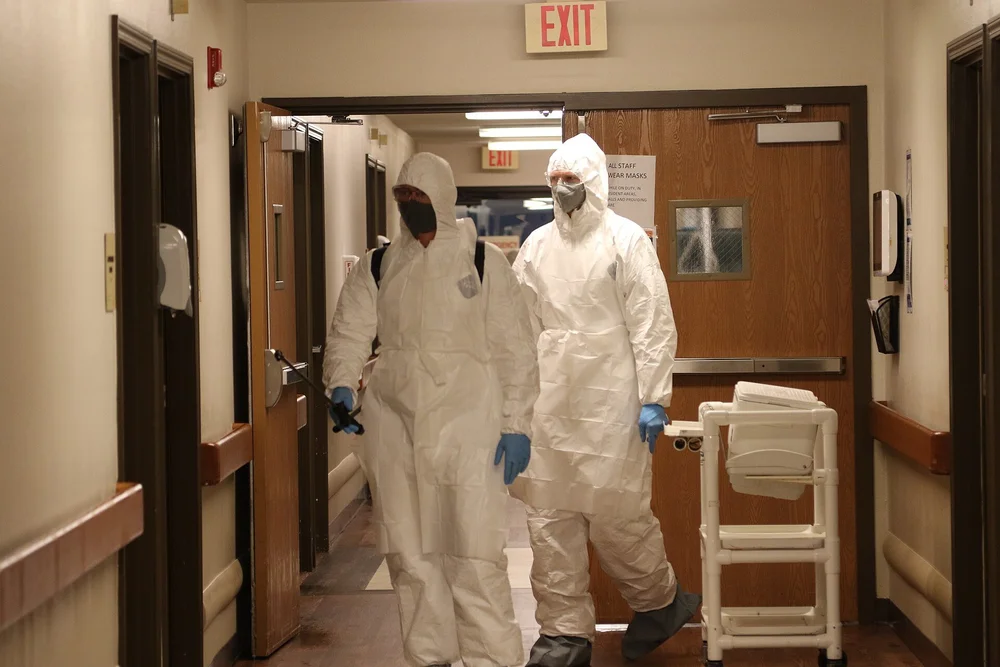
Photo: The National Guard, public domain, via Wikimedia Commons
How a scene ends up spread across a home or building
Spread is usually nobody's fault. It's what happens when people react to an emergency. The most common ways contamination travels are:
- Movement of the person who was hurt from one room toward a door or phone
- Foot traffic from occupants, neighbors, first responders and investigators
- Medical response, where treatment happens in a hallway, entry or doorway
- Hands and objects: light switches, door handles, banisters, phones, keys
- Well-meant cleanup attempts, where a towel or mop carries material into new areas
Tracked material on a hard floor can look like a faint smudge, and on patterned carpet it may not be visible at all. That's why we walk every route, not just the obvious room.
Mapping the affected areas first
Before any cleaning starts, we work out where contamination is and where it isn't. During the assessment we trace each route from the main area outward and note every surface that needs attention. We often sort areas into three groups:
| Zone | What it usually includes | Typical approach |
|---|---|---|
| Primary area | The room or space where the incident centered | Removal of porous materials, deep cleaning and disinfection |
| Travel paths | Hallways, stairs, entries, doorways | Targeted removal of affected carpet or runners, cleaning of hard surfaces and touch points |
| Unaffected rooms | Areas with no contamination found | Protected and kept off-limits to work traffic |
This map becomes the basis of the written scope, so you can see exactly what's included and why.
Containment zones and controlled foot traffic
Once you have several affected areas, the risk is that cleaning one contaminates another. Containment prevents that. Depending on the layout, we may:
- Hang plastic sheeting across doorways to separate work areas from clean rooms
- Lay protective floor covering along the route workers use
- Set up a single entry and exit point where protective equipment is put on and taken off
- Keep a clear line between areas that have been finished and areas still in progress
Our guide to how cleanup teams manage access and containment goes into more detail.
The order we work in
Sequencing matters. Working in the wrong order means walking through finished areas with dirty equipment.
Protect the clean areas
Rooms with no contamination are closed off first so they stay that way.
Work from the farthest point back
We usually start at the far end of the travel path, such as an upstairs bedroom, and finish at the exit, so cleaned areas aren't crossed again.
Stairs and hallways as their own stage
Stair treads, risers, banisters and runners are treated as a distinct task, because carpet on stairs often has to be removed and hard edges need careful cleaning.
Touch points throughout
Door handles, switches, railings and frames along every route are cleaned and disinfected with EPA-registered products used according to label directions.
Final walkthrough
We check each zone against the map before taking down containment.
Heating, cooling and shared air
A home's HVAC system moves air between rooms, and in apartments and offices it may serve more than one unit or suite. Odor and fine particles can travel the same way. Before we arrive, if it's easy to do, avoid running fans or the HVAC system in a way that blows air from affected areas into the rest of the building.
During the work, we look at return vents and registers in and near affected rooms and may cover them while we work. If a vent or grille itself has contamination, we include it in the scope. If ductwork needs more than cleaning at the opening, we'll tell you and recommend the right trade.
Who calls us, and what to do before we arrive
Multi-room calls often come from homeowners who returned after the police left and realized the problem wasn't limited to one room, from relatives of an older person who was hurt at home, and from building managers who found marks in a shared stairwell. In the meantime, a few safe steps help limit further spread:
- Pick one route through the property that avoids affected areas and ask everyone to use only that.
- Keep children and pets out of hallways and stairs that show marks.
- Don't vacuum or mop. Both can carry material into rooms that are currently clean.
- Leave shoes worn through affected areas by the door, and mention them to us.
Once police have released the property, call and we'll start with the map.
Why the scope and price grow with each room
People are sometimes surprised that a multi-room job costs considerably more than a single-room one. It isn't just more floor. Each additional area adds:
- Containment set-up and take-down
- Removal of more porous material, especially stair and hallway carpet
- More touch points to clean and disinfect
- More contaminated waste to package and dispose of in line with applicable Tennessee and federal requirements
- More time moving carefully between zones
Pricing is based on the written scope after the assessment, so you'll see each zone listed. Some property insurance policies may cover some of this work, depending on the policy; we provide photos, the scope and an itemized invoice for your insurer. Our guide to evaluating a quote can help you read it, and how pricing works explains our general approach.
Two-story homes, apartments and commercial buildings
Layout changes the work. In a two-story house, stairs are usually the most labor-intensive part. In an apartment building, contamination can reach shared hallways, elevators and stairwells, so the property manager needs to be involved; see crime scene cleanup for property managers. In a store or office, it may run from a back room across a sales floor to an exit, which is covered on our commercial crime scene cleanup page.
For multi-room jobs that aren't tied to a crime, such as a serious accident, see multi-room biohazard remediation. The multi-room cleanup guide covers planning in more depth. We travel from Nashville across our service area; scheduling is confirmed by phone.
Questions people ask
Can we use the unaffected rooms during the work?
Usually, if they can be reached without crossing a work zone. We'll agree which rooms are usable and which route to take in and out.
Do you clean stair carpet or replace it?
Stair carpet that has absorbed blood usually has to be removed, because the pad and tack strip underneath are affected too. Replacing it is a job for a flooring contractor afterward.
Should I turn off the air conditioning or heat?
If you can do so safely and comfortably, avoid running the system in a way that pulls air from affected areas. Don't put anyone at risk from heat or cold to do it. We'll check vents when we arrive.
How do you know you've found everywhere it spread?
We trace every route from the main area, check floors, walls, handles and frames along the way, and ask you who moved through the property afterward. That map becomes the written scope.
Is one long job or several visits better?
It depends on the size of the scope and whether you need part of the property back quickly. We'll suggest a plan during the assessment and explain the tradeoffs.
Sources
Get the whole property mapped
Call (615) 513-5112 any time. We'll trace every affected area and give you a written scope before any work begins.