Dried Blood Cleanup
Dried blood can be cleaned up, but it usually takes more than surface scrubbing. Once blood has had days to set, it has often soaked into whatever was underneath it. A stain that looks small on top of a rug may be much wider in the pad below.
You might be clearing a relative's house, moving into a new place, or only now noticing marks from an injury weeks ago. This page explains what drying changes, how we work out how far it went, and why scrubbing it yourself can make it worse.
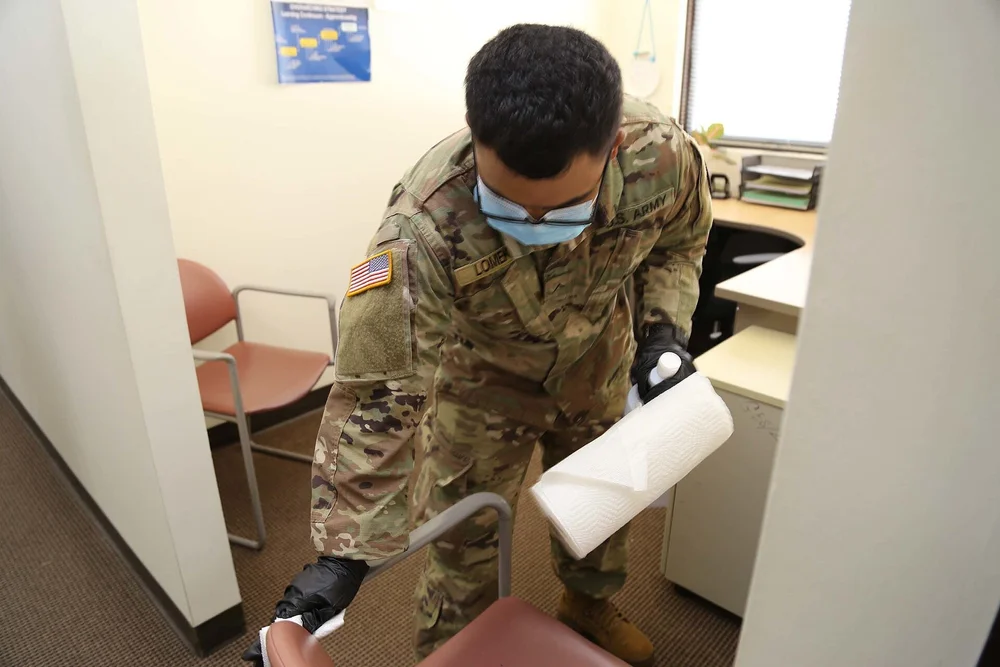
Photo: The National Guard, public domain, via Wikimedia Commons
How people usually find it
Most dried blood calls start with a discovery rather than an event. Something happened earlier, and nobody was in a position to deal with it at the time. Common examples:
- A family member clearing out a parent's home after a hospital stay finds old marks on a mattress, a recliner or a bathroom floor.
- Someone who lives alone had a nosebleed or a fall that they didn't mention, and relatives only see the aftermath later.
- A new owner or tenant pulls up a rug or moves furniture and finds staining underneath.
- A vehicle or a piece of furniture has been in storage, and the stains show up when it is uncovered.
Not every brown mark is blood. Rust, coffee, old adhesives and some pet stains can look similar. We look at the pattern, the location and the story around it before we decide how to treat it. If you aren't sure what you're looking at, describe it on the phone and we'll talk through it with you.
What changes once blood has dried
Fresh blood sits mostly on top of a surface for a short while. Given time, it moves. On porous materials it wicks outward and downward. As it dries, it bonds to fibers and fills pores, which is why old stains resist ordinary cleaners.
| Material | What we typically find | Likely outcome |
|---|---|---|
| Carpet and pad | Pad holds far more than the carpet face shows; stain often wider below | Section removed, subfloor checked and treated |
| Mattress | Fluid moves into foam and inner layers | Usually removed and disposed of |
| Unsealed or worn wood | Blood can enter grain and gaps between boards | Clean and disinfect; some boards may need a contractor to replace them |
| Tile and grout | Tile cleans well; grout lines hold residue | Deep cleaning of grout; damaged grout may need regrouting |
| Drywall and baseboards | Paper face absorbs; gaps behind trim collect drips | Clean if surface-only; cut out if absorbed |
Drying does not make blood harmless. The CDC notes that bloodborne viruses such as hepatitis B can spread through contact with infected blood, and some survive outside the body for a while. We treat old blood with the same care as fresh blood.
Why scrubbing tends to spread it
The instinct is to grab a brush and a carpet cleaner. With dried blood that usually backfires, for three reasons:
- Water re-wets it. Adding liquid loosens dried blood and lets it travel again, often into the pad and subfloor that were clean before.
- Brushing pushes it sideways. Agitation spreads residue into a wider ring around the original stain.
- Heat can set it. Hot water and steam can bind proteins in blood more firmly into fibers, which makes later removal harder.
The result can be a lighter-looking stain sitting on top of a larger hidden one. Our guide on what not to do before an assessment covers other common well-meant mistakes.
How we work out the extent
The goal of the assessment is to find the edge of the contamination, not just the visible stain. We use a combination of:
- Close visual inspection with strong, low-angle lighting, which shows residue and texture the eye misses in room light.
- Lifting and looking underneath. We fold back carpet, check under furniture feet and look behind trim.
- Following the history. Knowing roughly what happened tells us where else to look, such as a path to a bathroom or a chair the person sat in afterward.
- Checking the layers below. Where porous material comes out, we inspect the subfloor or wall behind it before treating.
Where an indicator test helps confirm whether residue is present on a surface, we may use one. Visual and physical inspection still does most of the work. You get a written scope that names each item and surface and what we plan to do with it. For a closer look at how decisions about individual materials are made, see how professionals decide whether materials can be remediated.
The cleanup, step by step
Protect the rest of the home
We set up a work area and cover the walkway so nothing is carried into clean rooms.
Remove what has absorbed blood
Affected carpet and pad, mattresses or fabric items are cut out or removed and sealed in packaging on site.
Loosen and lift residue
On hard surfaces we use cleaners suited to dried protein residue, lifting material rather than smearing it.
Disinfect
We apply EPA-registered disinfectants according to label directions and allow the required contact time.
Inspect again
We recheck the area under the same lighting and confirm we've reached clean material at the edges.
Dispose and record
Waste is disposed of in line with applicable Tennessee and federal requirements, and you get photos and an itemized invoice.
Before we arrive
You don't need to do much. Leave the stained items where they are, keep pets from lying on them, and close the room if you can. If the stains are in a home you're clearing for an estate, it's fine to keep sorting other rooms. Just set aside anything with staining rather than throwing it out, especially if you may be making an insurance claim. Our guide to preparing a property for remediation has a fuller checklist.
Scope, cost and where we work
With dried blood, cost depends mostly on how far the blood traveled below the surface, what materials are involved, how many rooms, and the volume of waste. We give a written scope before work begins and don't publish dollar figures. Some property insurance policies may cover part of this kind of cleanup, depending on the policy; we can supply photos, the scope and an itemized invoice for your insurer.
We travel from Nashville across Middle Tennessee. Scheduling for any address is confirmed by phone. See our service areas, including Davidson County and Sumner County.
Questions people ask
Is dried blood still a health risk?
It can be. Drying reduces some risks but doesn't remove them, and some viruses can survive on surfaces for a time. The standard approach is to treat all blood from another person as potentially infectious, old or new.
Can you tell how old a stain is?
Not precisely, and it isn't something we try to determine. We focus on how far it went and how to remove it. If you have questions about what happened, those are for the people involved or, where relevant, law enforcement.
I already tried a carpet cleaner on it. Is that a problem?
It's very common and it's fine to tell us. It may mean the affected area is larger than the stain suggests, so we'll check the pad and subfloor more widely.
Can a stained antique or keepsake be saved?
Sometimes. Hard, sealed pieces often clean well. Fabric, paper and soft wood are harder. We'll tell you honestly what we think is realistic and you decide. Nothing personal is thrown away without your say.
The stain is in a car. Do you handle that?
Yes. Vehicle interiors have their own challenges with foam seats and carpet. See vehicle biohazard cleanup.
Sources
Found something you weren't expecting?
Call (615) 513-5112 and describe what you see. We'll tell you whether it sounds like a job for us and what the next step would be.

