Understanding the Professional Cleanup Process from Inquiry to Completion
A professional biohazard cleanup moves through seven stages: you call or order online, we ask a few questions, someone assesses the property, you receive a written scope, the work is carried out, the work is documented, and the property is handed back to you. Each stage has a purpose, and none of them asks you to clean anything yourself.
This guide explains what happens at every step with Nashville 24/7 Biohazard Disposals, what you'll be asked to decide, and where the process can change. It's meant to remove the guesswork so you can focus on everything else that's happening.
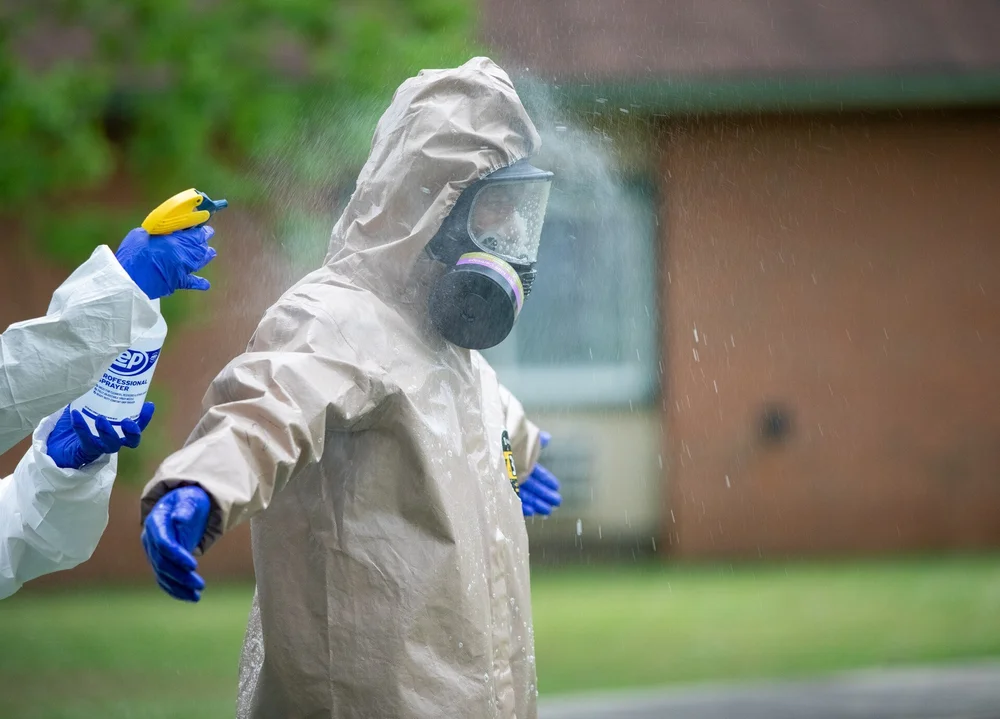
Photo: The National Guard, public domain, via Wikimedia Commons
The process at a glance
Every project is different, but the order of events stays the same. Knowing the order makes it easier to see where you are and what's coming next.
Inquiry
You call (615) 513-5112 or place an order through the Order Online page.
Initial questions
We gather the basics: location, property type, affected areas, release status and access.
Assessment
A team member looks at the affected areas and materials to understand what's involved.
Written scope
You receive a written description of the work, which forms the basis for the agreement and final price.
Remediation work
Contaminated materials are removed, surfaces are cleaned and disinfected, and waste is packaged for disposal.
Documentation
The work is recorded with photos, notes and an itemized invoice you can share with an insurer.
Handover
We walk you or your representative through what was done and what, if anything, comes next.
The rest of this guide takes each of these stages in turn. If you only need one piece, the section headings work as a map.
Before you reach out: release and safety
One thing has to happen before any cleanup company can start: the authorities must be finished with the property. If police or the county medical examiner are involved, they decide when the scene is released. In Tennessee, county medical examiners investigate sudden, unexpected, traumatic and suspicious deaths, so their involvement is common after the kinds of events we're called for.
You can still call us before the release. Many people do, because it helps to have a plan ready. We'll simply schedule the work for after the property is cleared.
In the meantime, the safest things to do are simple and don't involve cleaning:
- Keep people and pets out of the affected area.
- Close the door to the room if you can do so easily.
- Avoid running fans or the HVAC system into the area if that's simple to arrange.
- Hold off on throwing anything away until you've spoken with your insurer.
Our guide on what not to do before an assessment explains why well-meant early cleaning can make a job harder.
Stage 1: Your inquiry, by phone or online
There are two ways to begin. Both lead to the same process.
Calling
The phone line is answered at any hour, day or night. A call lets you ask questions straight away and hear what's likely to happen next. It's often the right choice when you're unsure what kind of help you need, or when the situation is complicated by an ongoing investigation, a rental arrangement or a family estate.
Ordering online
The Order Online page suits people who would rather start in writing, or who already know they want to proceed. Online orders take a $2,000 initial deposit. Please read that figure carefully: it is a deposit to begin the process, not the final price, and placing an order does not guarantee work begins within 24 hours. The final price is set by the written scope and your signed agreement.
After an online order, we contact you to confirm details and arrange the assessment. If anything about your situation means we're not the right fit, we'll tell you plainly.
Stage 2: A short set of questions
The first conversation is brief. We ask what we need to plan safely and leave the rest for later. You'll usually be asked about:
- The address and type of property: a house, apartment, business, hotel room or vehicle.
- Which rooms or areas are affected, as far as you know.
- Whether the scene has been released by police or the medical examiner.
- How we'll get in: keys, a lockbox, a property manager or a family member.
- Who has the authority to approve work on the property.
- Whether you've contacted your insurer.
You don't need to describe what happened, and you don't need every answer. Our guide to communicating with a cleanup company covers what to share and how to set limits.
This is also when scheduling begins. Our one team travels out from Nashville across Middle Tennessee, so we confirm timing by phone for every location. Distance and the current workload can affect when we arrive, and we won't promise a time we can't keep.
Stage 3: The on-site assessment
The assessment is where the real shape of the job becomes clear. A team member looks at the affected areas, identifies which materials are involved, and checks whether contamination may extend beyond what's visible on the surface.
Several things are considered at this stage:
- Surfaces and materials. Hard, sealed surfaces behave very differently from carpet, pad, mattresses, upholstered furniture and unsealed wood.
- Depth. Bodily fluids can move beneath flooring or into wall cavities. The assessment looks for signs of that.
- Extent. How many rooms, how much floor area, and whether more than one level of the building is involved.
- Access and logistics. Stairs, elevators, parking and building rules all shape how the work is organized. See our guide on how property access affects a cleanup.
- Belongings. Items you want kept are noted so they can be protected or discussed.
For a fuller picture of what happens during this visit, read how a professional biohazard assessment works.
Stage 4: The written scope and agreement
After the assessment, you receive a written scope. It is the single most important document in the process, because it states what will be done and forms the basis of the price.
What a scope typically describes
- The rooms and areas included.
- Materials to be removed, such as carpet and pad, a mattress, or a section of drywall or subfloor.
- Surfaces to be cleaned and disinfected.
- How waste will be handled.
- Any items set aside for your decision.
- What is not included, such as rebuilding or repainting.
How price relates to the scope
Price is based on factors like the extent of contamination, the types of materials, the number of rooms, access, and waste volume. We don't publish price ranges, because two jobs that sound alike can differ a great deal once someone has seen them. The pricing page and our guide on how biohazard cleanup pricing is determined explain those factors.
Approval
Work begins after the person with authority over the property approves the scope and agreement. If you placed an online order, the deposit is applied as set out in that agreement. Take the time you need to read it. If something is unclear, ask, and if you're comparing companies, our guide to evaluating a biohazard cleanup quote can help.
Stage 5: Carrying out the work
The work itself follows a consistent pattern, adjusted to the property. You don't need to be present; many clients prefer not to be.
Set up and protect
The team puts on protective equipment and sets up the work area so contamination isn't carried into clean parts of the property. Our guide on access and containment explains the thinking.
Remove contaminated porous materials
Items that can't be reliably decontaminated, such as soaked carpet and pad, mattresses or affected drywall, are removed and packaged. More on this in what happens to contaminated porous materials.
Clean, then disinfect
Remaining surfaces are cleaned to remove visible material and then disinfected with EPA-registered products used according to label directions, including keeping the surface wet for the full contact time the label requires.
Address odor
Where odor is part of the problem, it's treated at its source rather than covered up. See biohazard remediation and odor concerns.
Package and remove waste
Contaminated material is packaged and disposed of in line with applicable Tennessee and federal requirements. In Tennessee, medical waste is classed as a special waste and generally can't go to a regular landfill unless it has been treated to be non-infectious.
If the team finds something during the work that changes the scope, such as contamination under a floor that wasn't visible before, they stop and explain it to you. Additional work is approved before it's done.
Stage 6: Documentation
Throughout the job, the work is recorded. These records protect you, help with insurance, and give owners and managers a clear account of what was done.
Documentation usually includes:
- Photos of affected areas before and after work.
- A list of materials and items removed.
- The written scope and any approved changes.
- An itemized invoice.
Some property insurance policies may cover some of this work, though that depends entirely on your policy and your insurer. Whatever the outcome, these records are what an adjuster typically asks for. You never have to look at the photos yourself; we can send them straight to your adjuster if you prefer. Our guide to documentation and insurance questions after an incident go into more detail. Property managers may also find what property managers should document useful.
Stage 7: Handover and what comes after
When the work is complete, we hand the property back. That usually means a walkthrough with you or someone you choose, or a written summary if you'd rather not visit.
What the handover covers
- Which areas were treated and what was removed.
- Items that were set aside and where they are.
- Whether any repairs will be needed before the space is used normally again.
- Copies of documentation for you and, if you choose, your insurer.
Repairs are a separate step
When drywall, flooring or subfloor has been removed, the space will need rebuilding before it looks finished. Repairs such as new drywall, flooring and paint are generally a contractor's job. We'll tell you if your project will need one so you can plan. Our guide on biohazard cleanup versus standard restoration explains where one ends and the other begins.
Where the process can vary
The seven stages don't change, but how they play out does. A few common variations:
| Situation | How the process adapts |
|---|---|
| Rental or apartment unit | The owner or manager usually authorizes the work, and building rules shape access. See our apartment manager's guide. |
| Business or hotel | Scheduling works around operations and staff, and a single coordinator helps. See commercial biohazard cleanup. |
| Vehicle | Assessment focuses on upholstery, carpet and hidden spaces. See vehicle biohazard cleanup. |
| Death discovered after some time | Assessment pays particular attention to subfloor and odor. See unattended death cleanup. |
| Several rooms affected | The scope is organized room by room. See our multi-room cleanup guide. |
What you decide, and when
The process is designed so that you make a small number of clear decisions at sensible points, rather than being asked everything at once. Here is where your input is needed, and where it isn't.
| Stage | Your decision | What you can leave to us |
|---|---|---|
| Inquiry | Whether to call or order online, and who will be the main contact. | Working out what type of service fits the situation. |
| Initial questions | How access will be given and who can approve work. | Planning equipment, crew and travel. |
| Assessment | Which belongings matter to you and should be protected or discussed. | Identifying affected materials and how far contamination extends. |
| Written scope | Whether to approve the scope and agreement as written, or ask questions first. | Describing the tasks, materials and waste handling in plain terms. |
| Work | Approving any change in scope if something unexpected is found. | Removal, cleaning, disinfection, odor treatment and waste packaging. |
| Documentation | Who receives the records, such as you, a relative or your adjuster. | Taking photos, listing removed items and preparing the invoice. |
| Handover | Whether to attend a walkthrough or receive a written summary. | Explaining what was done and whether a contractor is needed next. |
If a decision feels too heavy on a particular day, say so. Most can wait a little, and the person you've named as a contact can often make them on your behalf.
Other people you may hear from along the way
A cleanup rarely happens in isolation. Knowing who else may be part of the picture helps you understand why some steps have to wait.
Law enforcement and the medical examiner
They control the timing of the release. Their work comes first, and a cleanup company has no role in it. If you have questions about an investigation, direct them to the agency involved rather than to us.
Your insurer
An adjuster may want to see the property, review documentation, or talk to you before items are discarded. Telling us early that a claim is open lets us keep the records an adjuster typically asks for.
Landlords, property managers and associations
In apartments, condominiums and rentals, building management often has rules about parking, elevators, hours of work and how waste leaves the property. We coordinate with them so you don't have to relay messages back and forth.
A repair contractor
If materials such as drywall or subfloor are removed, a contractor will usually be the next person through the door. We'll tell you whether that's likely before the work starts, so it doesn't come as a surprise at the end.
Common misunderstandings about the process
"The deposit is the price."
It isn't. The $2,000 deposit taken with online orders starts the process. The final price comes from the written scope and agreement.
"Someone has to stay at the property."
Usually not. Access can often be arranged with a key, a lockbox or a property manager.
"The cleanup company will repair everything."
Our work is cleanup and remediation: removing contaminated materials, cleaning, disinfecting and deodorizing. Rebuilding is generally a contractor's job.
"If it looks clean, it is clean."
Visible cleaning is only part of the work. Bodily fluids can carry pathogens such as hepatitis B, hepatitis C and HIV, and contamination can sit beneath surfaces. That's why the process includes assessment and disinfection, not just wiping. Our guide on the limits of household cleaning explains this calmly and in more depth.
The whole path in a few lines
You make contact by phone or online. We ask a short set of practical questions. Someone assesses the property. You receive a written scope that sets out the work and forms the basis of the price. The team removes what can't be saved, cleans and disinfects what remains, and packages waste for proper disposal. Everything is documented, and the property is handed back with a clear account of what was done and whether a contractor is needed next.
You can step in or step back at any point. If you'd like to start, call (615) 513-5112, use the online order form, or browse our full list of services first.
Questions people ask
Is the $2,000 online deposit the total cost?
No. It's an initial deposit taken when you order online. The final price is based on the written scope after an assessment and set out in your agreement. The deposit also doesn't guarantee work begins within 24 hours.
Can work begin before the police have released the property?
No. A scene must be released by police and, where involved, the medical examiner before cleanup can start. You can call ahead to make arrangements so the plan is ready once the release happens.
What happens if more contamination is found during the work?
The team stops and explains what was found and how it affects the scope. Additional work is approved by you, or by the person authorized to make decisions, before it goes ahead.
Do I need to be there for the assessment?
Not necessarily. Someone needs to provide access and someone with authority needs to approve the scope, but that can often be arranged without you entering the affected area or staying on site.
How long does the whole process take?
It depends on the extent of the contamination, the materials involved, the number of rooms and access. The assessment gives a much clearer idea. We'll talk you through expected timing once we've seen the property.
Will I get paperwork I can give to my insurance company?
Yes. We can provide photos, the written scope and an itemized invoice. Whether your policy covers any of the work is up to your insurer, so it's worth calling them early.
What areas of Middle Tennessee does the process cover?
The same process applies across our coverage in Davidson, Rutherford, Williamson, Montgomery, Sumner, Wilson, Maury, Robertson, Dickson, Cheatham, Macon, Hickman, Smith, Cannon and Trousdale counties. Scheduling is confirmed by phone, since distance from Nashville can affect timing.
Can I cancel or pause after the assessment?
Yes. The assessment and written scope are there so you can decide with full information. If you need time to talk to family, an insurer or a property owner before approving the work, tell us. If you placed an online order, how the deposit is handled is set out in the agreement, so it's worth reading that section and asking us about anything that isn't clear.
Do you rebuild the area after removing drywall or flooring?
No. Our work covers removal of contaminated materials, cleaning, disinfection and deodorization. Rebuilding with new drywall, flooring or paint is generally a contractor's job. We'll tell you during the assessment if your project is likely to need one, so you can line up that help ahead of time.
What if I'm handling this for a relative who lives in another state?
That's workable. The process can be managed largely by phone and email, with access arranged through a neighbor, property manager or lockbox. Documents can be signed and returned remotely, and we can send records to you, the estate's representative or the insurer as you direct.
Sources
Start with a phone call or an online order
Call (615) 513-5112 any time to talk through the first stage, or use the Order Online page if you would rather begin in writing. Either way, the next step is a short conversation about your property.

