A Guide to Multi-Room Biohazard Cleanup
A multi-room biohazard cleanup is a job where blood, bodily fluids or other biological contamination reaches more than one room, a hallway or stairway, or the building's air system. These jobs are planned in phases: map every affected area, contain them so clean rooms stay clean, work from the most contaminated zone outward, and verify each area before moving on.
This guide explains how that planning works, why contamination travels further than people expect, what affects time and cost on a larger job, and what owners, families and managers can do to keep the project organized.
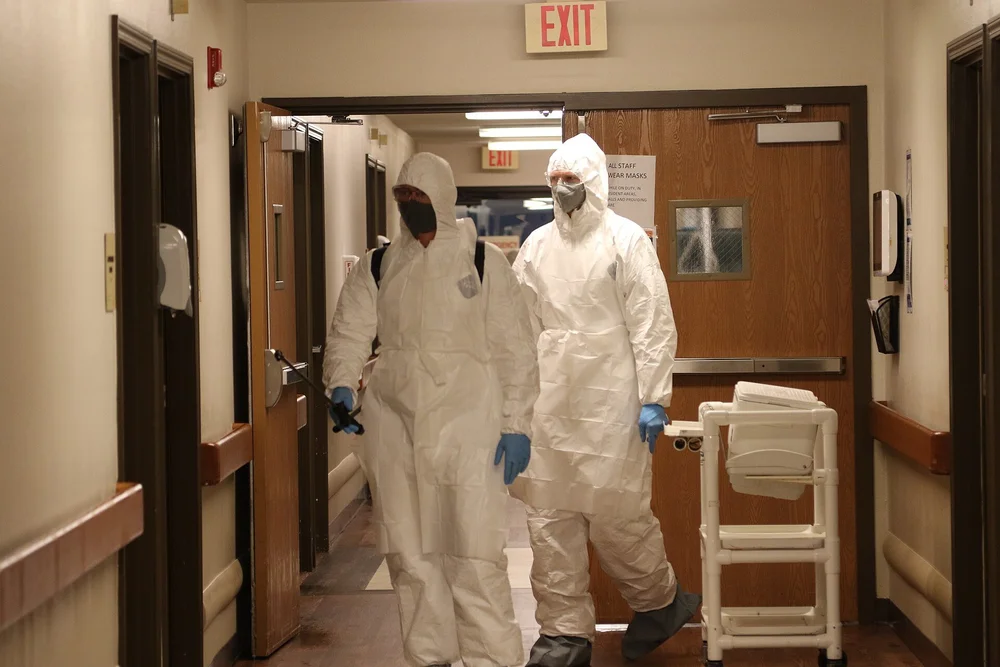
Photo: The National Guard, public domain, via Wikimedia Commons
What makes a job multi-room
There is no official threshold. In practice, a job becomes multi-room when the cleanup has to be planned as a set of connected areas rather than a single space. Typical signs include:
- Biological material in two or more rooms, or in a room plus the hallway or stairs between them.
- A path of contamination from one place to another, such as from a bedroom to a bathroom to a front door.
- Fluids that have moved through the structure, for example through a floor into the ceiling below.
- Odor that has spread through the home on the heating and cooling system.
- Several separate units affected in the same building, such as neighboring apartments or hotel rooms.
Any type of incident can lead to this: a violent crime, an injury where the person moved around, a death that went undiscovered, or a medical emergency with responders working in several spaces. Our service pages for multi-room crime scene cleanup, multi-room blood cleanup and multi-room suicide scene cleanup cover how each situation is handled. This guide focuses on the planning that sits behind all of them.
Why contamination reaches more rooms than you expect
Families are often surprised that an incident in one room affects others. The reasons are usually ordinary:
Movement
People walk. An injured person may go to a bathroom or try to reach a phone. Family members, neighbors, police and paramedics all move through the home, and shoes carry traces from room to room. None of this is anyone's fault; it is what happens in an emergency.
Gravity and the building itself
Liquids follow the floor. They run to the lowest point, under door thresholds, beneath baseboards and between floorboards. In multi-story homes and apartments they can pass through subfloor into the ceiling or wall cavities below.
Air movement
Heating and cooling systems pull air from one room and push it into others. That does not usually spread biological material in a meaningful way, but it does carry odor, which is why a smell can seem to be everywhere even when the source is in one room. Our guide on biohazard remediation and odor explains the difference between removing the source and masking the smell.
Time
The longer material sits, the further it soaks into porous materials. Jobs discovered after several days are more likely to involve subfloor and multiple rooms. See cleanup after a death discovered after an extended period for that specific situation.
Mapping the job: the assessment on a larger property
On a multi-room job, the assessment is closer to a survey. The technician is building a map of where contamination is, where it might be, and where it is definitely not. That map drives everything else.
A thorough assessment on a larger job usually covers:
- Each room with visible contamination, including floors, walls up to the height affected, and furniture.
- The routes between those rooms: hallways, stairs, doorways and thresholds.
- Rooms below or beside the affected areas, looking for staining on ceilings or walls.
- Bathrooms and kitchens, which are common secondary sites.
- Return air vents and filters near the affected areas.
- Rooms that appear unaffected, so they can be confirmed clean and kept that way.
Questions the technician will ask you
Expect a few practical questions that help complete the map: Which rooms did people go into after the incident? Has anything been moved or cleaned already? Where is the air system's return? Is there a basement or crawlspace under the affected area? Short answers are enough, and it is fine to say you do not know.
That last point is easy to overlook. Confirming which rooms are clean is as useful as finding the contaminated ones: it tells you where people can stay, where belongings can be moved, and where the work will not go. The general process is described in how professionals assess affected rooms and materials.
Zones: dividing the property into working areas
Once the map exists, the property is usually divided into zones. The names vary between companies, but the idea is the same.
| Zone | What it is | Who goes in |
|---|---|---|
| Work zone | Areas with biological contamination that need removal and disinfection | Technicians in full protective equipment only |
| Transition area | A space just outside the work zone where protective gear is put on and taken off and waste is staged | Technicians |
| Clean zone | Areas confirmed unaffected | Occupants, owners, other trades |
Zones shrink as the job goes on. A hallway that started as part of the work zone becomes a clean zone once it has been cleaned and checked, and the transition area moves with it. Our guide to how cleanup teams manage access and containment covers barrier types and entry procedures in more detail.
Containment on a multi-room job
Containment is what keeps a three-room job from becoming a five-room job. Typical measures include:
- Plastic sheeting over doorways, sometimes with a zippered entry.
- Floor protection along the path technicians use to carry materials out.
- Sealing return air vents in the work zone, or switching the system off if that is practical, so odor and dust are not drawn through the house.
- A single, defined route for waste leaving the building.
- Clear signs or verbal agreements about which doors not to open.
Protecting the people doing the work
Inside the work zone, technicians wear protective equipment chosen for the task: typically disposable coveralls, gloves, eye protection and respiratory protection. OSHA's Bloodborne Pathogens Standard sets out the employer's duties for workers with occupational exposure to blood, including an exposure control plan, training and protective equipment. Gear is put on and taken off in the transition area so nothing worn in the work zone is carried into clean rooms. Our guide to cleanup equipment and PPE goes into what each item is for.
On some properties, especially apartments and hotels, containment also has to account for neighbors. Shared corridors, elevators and stairwells may need protection, and the route out of the building has to be agreed with the building manager.
The phases of a multi-room cleanup
Every job has its own plan, but larger projects usually follow a recognizable order.
Stabilize
Containment goes up, air movement is controlled, and any urgent issue, such as fluid still able to spread, is dealt with first.
Recover belongings
Items the family or owner has asked for, and items that are clearly unaffected, are moved to a clean zone. This is easier to do at the start than halfway through.
Remove porous materials
Carpet, pad, mattresses, upholstered furniture and any affected drywall or subfloor are removed, packaged and staged for disposal. Work usually starts in the most affected room.
Clean and disinfect
Remaining surfaces are cleaned to remove visible material and then disinfected with EPA-registered disinfectants used according to label directions.
Work outward
The team moves from the most contaminated room toward the routes and secondary areas, so cleaned spaces are not walked through again with dirty equipment.
Deodorize
Once source material is gone, odor control addresses what remains in the air and in the structure.
Verify and hand over
Each area is checked before containment comes down. The owner receives photos and a summary of what was done in each room.
Some steps overlap. On a large house, one room may be in the cleaning phase while removal is still happening in another.
Why the order matters
Working from the most affected area outward means equipment, boots and waste bags only ever move from dirty toward clean once, at the end of each phase. If the order were reversed, a hallway cleaned in the morning could be walked through again with a loaded bag in the afternoon. Keeping a single direction of travel is one of the simplest ways to prevent a cleaned room being affected a second time.
Occupied or vacant: how it changes the plan
Whether people are living in the property during the work makes a real difference.
If the home is occupied
- The clean zone must include a bathroom, a place to sleep and a way in and out that does not cross the work zone.
- Work may be split across more than one visit.
- Containment needs to stay up overnight and be robust enough for daily life around it.
- Medications, documents and daily essentials should be moved to the clean zone first.
If the property is empty
- The whole property can be treated as one project with fewer constraints.
- Access arrangements, such as a lockbox, matter more than schedules.
- Utilities need to stay on for lighting and equipment.
- A walkthrough with the owner or executor at the end is especially useful.
For estates and homes where the owner has died, our page on estate and property death cleanup covers the extra considerations.
Deciding what stays and what goes across several rooms
On a large job, the same questions are asked about hundreds of items. Is it porous? Was it affected? Can it be cleaned to a safe standard, and is it worth doing so? A consistent approach matters because owners and insurers will want to understand why one chair was kept and another removed.
As a rule of thumb, hard, sealed items that were affected on the surface can usually be cleaned. Porous items that absorbed biological material, like mattresses, upholstery and carpet, usually cannot. Items in the clean zone are left alone. The detail of these decisions is covered in how professionals determine whether materials can be remediated and contaminated furniture and material assessment.
Before any significant item is removed, owners should check with their insurer whether it needs to be inspected or photographed first. We can photograph items room by room so there is a record of what left the property.
What affects time and cost on a larger job
Multi-room jobs cost more and take longer than single-room jobs, but the number of rooms on its own does not set the price. What matters is the work in each one. The main factors are:
- Extent in each area. A hallway with a few spots is a different task from a bedroom where fluid reached the subfloor.
- Materials. Carpet and subfloor removal takes longer than cleaning tile or sealed wood.
- Structure. Contamination that has moved into wall cavities or the ceiling below adds removal and access work.
- Contents. A furnished home with a lot of belongings takes longer than an empty unit.
- Access. Stairs, upper floors, narrow corridors and distance to where the waste vehicle can park all add time.
- Waste volume. More removed material means more packaging and disposal.
- Occupancy. Working around residents can split the job into several visits.
The written scope you receive after the assessment should list each area and what will happen in it. That makes it easier to compare with your insurer's expectations and to see where the cost comes from. Our guides to how pricing is determined and how to evaluate a cleanup quote explain what a good scope should contain.
If you book through our Order Online page, it involves a $2,000 initial deposit. The deposit is not the final price, and it does not guarantee work begins within any particular time frame.
After the cleanup: the rebuild is a separate project
A multi-room job often leaves a property with bare subfloor, open wall sections or missing trim. That is expected. Biohazard cleanup ends when contamination is removed and the area is disinfected; putting the rooms back together is reconstruction, which is a contractor's work.
We do not rebuild, but we tell you during the assessment which rooms are likely to need a contractor afterwards. That lets you get repair estimates early and give your insurer a full picture. Our guide to biohazard cleanup versus standard restoration describes the handoff.
It helps to keep the two projects in sequence: contractors should not begin until the biohazard work is finished and you have the room-by-room summary. That avoids anyone opening a wall or lifting a floor in an area that has not yet been cleaned.
Keeping a larger project organized
Bigger jobs involve more people: family members, landlords, insurers, adjusters, contractors and sometimes building managers. A few habits keep things clear:
- Choose one person as the main contact for the cleanup company.
- Keep a simple log of calls with your insurer: date, name, what was said.
- Ask for the written scope to be organized by room or area.
- Agree in advance which belongings to search for and set aside.
- Keep copies of photos and invoices together in one folder.
Our guide on documentation in biohazard remediation describes the records that tend to be useful later.
Mistakes that make multi-room jobs bigger
Cleaning the obvious room and closing the door
If the routes and secondary areas are not checked, traces remain in hallways and bathrooms, and odor lingers. It is common for a second visit to be needed because only the obvious room was addressed the first time.
Running the heating and cooling at full power
It is natural to want fresh air moving, but drawing air from an affected room through the rest of the house spreads odor. If it is easy to avoid, leave the system off or set it so it is not pulling from that area.
Moving furniture between rooms
Dragging an affected rug or chair into the garage or another room creates a new affected area. Leave items where they are.
Starting repairs too soon
New flooring or paint over an area that was not fully cleaned can trap material and odor, and may mean pulling out new work.
Letting several companies work at once
Having a general cleaner, a carpet company and a biohazard company on site at the same time confuses the zones. One coordinated plan is simpler.
Where we take on larger jobs
Nashville 24/7 Biohazard Disposals is one team based in Nashville, traveling to properties across Middle Tennessee. Larger jobs are scheduled by phone because the size of the project and the distance both affect timing. You can see the counties we cover on our service areas page, including Davidson County, Rutherford County and Williamson County.
A short planning checklist for larger cleanups
- Keep everyone out of the affected areas and the routes between them.
- If it is easy to do, stop air from being pulled out of the affected rooms.
- Do not move affected items between rooms.
- Call your insurer before anything is thrown away.
- Arrange an assessment that covers the whole property, not only the obvious room.
- Ask for a scope written room by room.
- Plan the rebuild as a separate step once cleanup is finished.
Call us at (615) 513-5112 or use our contact page to arrange an assessment.
Questions people ask
How do I know if contamination has reached the floor below?
Look for discoloration or a damp area on the ceiling under the affected room, but do not open the ceiling yourself. The assessment will check rooms below and beside the affected areas as a matter of course.
Does the whole house need to be cleaned if odor is everywhere?
Not necessarily. Odor often spreads further than contamination. Once the source is removed, deodorization can address the rest of the home without treating every room as contaminated. The assessment separates the two.
Do you clean the ductwork?
We check vents and filters near the affected areas and replace filters as part of the job where needed. If the assessment suggests the duct system itself needs specialist cleaning, we will tell you and explain why.
Can the work be done over several days?
Yes, and on large or occupied properties it often is. Containment stays in place between visits, and the scope will say how the work is expected to be phased.
Can I get separate prices for each room?
We organize the written scope by area, which shows what will happen in each room. That usually gives owners and insurers the breakdown they need to understand the total.
What happens with several affected apartments in one building?
Each unit is assessed, and the shared areas between them are treated as part of the plan. The building manager usually becomes the main contact, and the route for waste through shared spaces is agreed in advance.
Should I stay somewhere else during a multi-room cleanup?
It depends on how much of the home is affected and whether a usable clean zone remains, with a bathroom, a bedroom and a separate route in and out. If those are not available, staying with family or in a hotel for the duration is usually more comfortable. Some insurance policies help with temporary housing, so ask your insurer.
Will neighbors in an attached home be affected?
Usually not, but shared walls and floors in townhomes and duplexes are checked during the assessment if the affected area is next to them. If anything suggests material has crossed into a neighboring unit, we will tell the owner so it can be discussed with the neighbor or the building manager.
Is a multi-room job always more serious?
Not always. Sometimes it means small traces in several places rather than heavy contamination in one. The plan reflects what is actually found, room by room.
Sources
Plan the whole property, not just one room
Call (615) 513-5112 to arrange an assessment that maps every affected area and gives you a room-by-room scope.

