How to Arrange Cleanup After a Gunshot Incident
After a gunshot incident, cleanup can only begin once police, and the medical examiner if they are involved, have released the property. From there, the practical order is simple: get the case number, call your insurer, ask about victim compensation if a crime occurred, and call a professional biohazard cleanup company for an assessment.
This guide walks through each of those steps in plain language. It covers who decides when you can go back in, what the cleanup includes and what it does not, how Tennessee's Criminal Injuries Compensation program treats cleanup costs, and the questions worth asking your insurance company before anything is thrown away.
If you or someone close to you is struggling after this, you can call or text 988 at any hour to reach the 988 Suicide & Crisis Lifeline. If the incident involved someone in your home and you do not feel safe, the National Domestic Violence Hotline is at 1-800-799-7233.
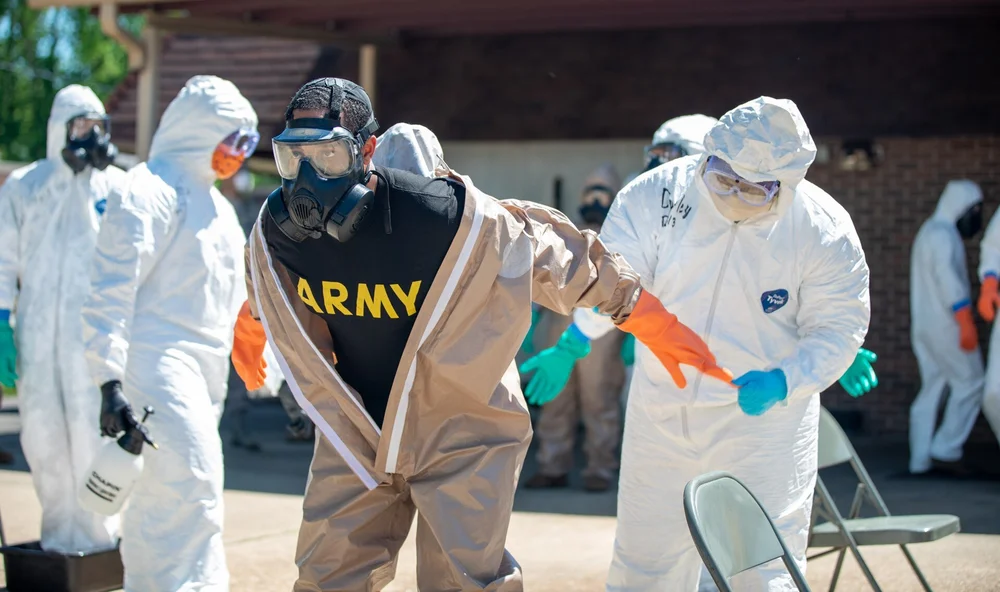
Photo: The National Guard, public domain, via Wikimedia Commons
The first hours: safety comes before anything else
If anyone is hurt or still in danger, call 911. Nothing about cleanup matters until people are safe and emergency services have done their work.
Once police arrive, the property becomes part of an investigation. Officers and detectives may need to photograph rooms, collect items and take statements. That can take a few hours or considerably longer, depending on what happened. During that time you will usually not be allowed back inside, even to collect a phone charger or medication. If you need something urgently, tell an officer; they can sometimes retrieve it for you.
Use this waiting time for small, useful things rather than trying to plan everything at once:
- Find somewhere to stay for a night or two, with family, a friend or a hotel.
- Write down the name of the officer or detective you spoke with and any report or case number they give you.
- Arrange care for children or pets who normally live at the property.
- Let one trusted person know what is happening so they can help field calls.
You do not need to make every decision today. Most of the steps in this guide can wait until you have slept and the scene has been released.
Who decides when the scene is released
Two groups can control access to a property after a shooting. Law enforcement controls the scene while they investigate. If a person died, the county medical examiner is also involved. In Tennessee, county medical examiners investigate sudden, unexpected, traumatic and suspicious deaths, so a fatal shooting will normally be part of their work as well.
A professional cleanup company cannot start work, or even walk through to assess, until the scene is released. Starting early could disturb evidence. Ask the investigating officer two direct questions:
- Has the property been released, and on what date?
- Are there any rooms, vehicles or items you still need to hold?
Sometimes the house is released but a car, a firearm or certain belongings are kept as evidence. That is normal. Items held by police are returned, or not, through their own process, and the cleanup team will work around anything that is still under their control.
If the medical examiner is involved
The Tennessee medical examiner system notes that forensic autopsies are performed at regional forensic centers and are not billed to the family, and that the written report usually takes about 10 to 12 weeks. You do not need that report to arrange cleanup. Once the property itself is released, cleanup can be scheduled while the medical examiner's work continues separately.
Who to call, and in what order
People often freeze because there are so many calls to make. This order works for most households:
The investigating officer
Confirm the release and get the case or report number. Your insurer and any compensation claim will ask for it.
Your property or renter's insurer
Open a claim, or at least ask whether one makes sense. Ask before throwing anything away; the questions to raise are listed further down this page.
A victim advocate, if a crime occurred
Tennessee district attorneys' offices have victim witness coordinators whose role includes sharing information about criminal injuries compensation. Police can usually tell you who to contact.
A biohazard cleanup company
Call for an assessment once the property is released. A first call is short and does not commit you to anything.
Your landlord or property manager, if you rent
They need to know, and they may want to arrange or approve the cleanup themselves.
You can call Nashville 24/7 Biohazard Disposals at (615) 513-5112 at any point in that list, even before you have reached your insurer. Our phone line is answered day and night, and we can explain what an assessment involves so you know what to tell the insurance company.
What gunshot scene cleanup actually includes
Gunshot scene cleanup is a form of traumatic incident scene cleanup. Its purpose is narrow and practical: to remove blood and other biological material from the property, take out materials that cannot be safely cleaned, and disinfect what remains so the space is safe to use again.
In practical terms, the work usually involves:
- Cleaning and disinfecting hard surfaces such as tile, sealed wood, countertops, metal and glass, using EPA-registered disinfectants according to label directions.
- Removing porous materials that have absorbed biological material, for example carpet and pad, mattresses, upholstered furniture, and sometimes sections of drywall or subfloor.
- Checking places the eye does not reach straight away, such as beneath flooring, behind baseboards and inside furniture.
- Packaging contaminated material and disposing of it in line with applicable Tennessee and federal requirements.
- Deodorizing the affected area once the source material is gone.
Why porous items are removed rather than cleaned is explained in more depth in our guide to what happens to contaminated porous materials.
What cleanup does not include
Cleanup and repair are separate jobs. Holes in walls, damaged doors, broken glass and flooring that has to be removed will need a contractor to rebuild. We do not do reconstruction, but we will tell you during the assessment whether your project is likely to need one, so you can line that up and give your insurer a complete picture. Our guide on biohazard cleanup versus standard restoration covers where one ends and the other begins.
Tennessee victim compensation and cleanup costs
If the shooting was a crime and it happened in Tennessee, the state's Criminal Injuries Compensation program, run by the Tennessee Department of Treasury, may help with cleanup. According to the program, it may cover up to $3,000 for cleaning and removal of materials when the crime occurred in the victim's home or the home of an eligible relative.
Key rules to know
- The crime must have happened in Tennessee.
- It generally must be reported to law enforcement within 15 days, though exceptions exist (for example, for minors or where there is good cause).
- A claim must be filed within two years of the crime, unless good cause is shown.
- The cleanup amount covers cleaning and removal of materials only. Repairs and replacement are not covered.
- The program is a payer of last resort. It does not pay costs that insurance or another source covers.
That last point matters for planning. If you have property insurance, the program expects other sources to be used first, and it considers what is left. Do not assume one or the other will pay; ask both.
When the program may not apply
Eligibility depends on the facts. The program covers victims of crime, so an incident that police do not treat as a crime, such as a death by suicide, may fall outside it. The program also asks that victims cooperate with law enforcement and that their own conduct did not contribute to the crime. If you are unsure, contact the program or a victim witness coordinator directly; they can tell you what applies to your situation. We cannot decide eligibility, and we will not promise that a claim will be paid.
What we can do is provide an itemized invoice and a written scope of the cleanup work, which are the kinds of documents a claim usually needs.
Questions to ask your insurance company
Some homeowner's, renter's, auto and commercial property policies may cover part of a cleanup like this. Whether yours does depends entirely on the policy and on the insurer's decision. The clearest way to find out is to ask specific questions and write down the answers, including the name of the person you spoke with and the date.
- Does my policy cover biohazard or trauma scene cleanup, and under which part of the policy?
- Is there a deductible, and does it apply here?
- Do you need to inspect the property before cleanup begins, or can photos and a written scope stand in?
- Can I choose the cleanup company, or do you require approval?
- Are contents, such as a sofa or mattress that has to be removed, covered separately?
- Does the policy help with somewhere to stay while the home is unusable?
- What documents do you need from the cleanup company?
On that last question, Nashville 24/7 Biohazard Disposals can provide photos, a written scope and an itemized invoice that you can pass to your insurer. We do not bill insurers directly and cannot predict what a policy will pay. Our separate guide to insurance questions after a biohazard incident goes further into deductibles, contents claims and keeping records.
If the incident happened in a vehicle
Car interiors are almost entirely porous: seats, headliners, carpet and seat belts all absorb fluids. Auto policies vary widely in how they treat this. Ask the same questions of your auto insurer, and see our page on vehicle biohazard cleanup for how vehicle work differs from a room.
If you rent, or the property belongs to someone else
When a shooting happens in a rental, both the tenant and the owner are affected, and it is easy for each to assume the other is handling cleanup. Talk early. A landlord will usually want to choose or approve the company, and the owner's insurance may be the one that responds to damage to the building itself.
Tenants should still contact their own renter's insurer about personal belongings and temporary housing. Landlords and managers will find more detail in our landlord's guide to biohazard cleanup and on our page for crime scene cleanup for property managers.
If the incident took place at a family member's home and that person has died, the executor or next of kin usually becomes the decision-maker. You do not have to wait for probate to protect the property from further damage, but it helps to agree within the family who will be the main contact for the cleanup company.
What you can safely do before the assessment
It is natural to want to clean up yourself, especially for a parent or partner. Please do not. Blood can carry bloodborne pathogens such as hepatitis B, hepatitis C and HIV, according to the CDC, and the emotional weight of doing this work for someone you love is heavy in its own way.
Helpful steps
- Keep children, pets and visitors out of the affected room.
- Close the door to that area if you can.
- Avoid running fans or turning the heating and air toward the room if that is easy to avoid.
- Take wide photos from the doorway if your insurer asks for them.
- Gather the case number and your policy details.
Things to hold off on
- Scrubbing, bleaching or steam-cleaning any surface.
- Throwing away furniture or rugs before your insurer has been told.
- Pulling up carpet or moving heavy items.
- Letting a general cleaning service or handyman start work.
- Posting photos of the scene online.
Our guide on what not to do before a cleanup assessment explains the reasons behind each of these in more detail.
How the cleanup itself usually runs
Every property is different, but the sequence is similar from job to job.
Phone conversation
We ask where the property is, which rooms are affected, whether it has been released, and how you would like us to get access. You can stay away from the property for all of it if you prefer.
On-site assessment
A technician walks the affected area, checks surrounding rooms and materials, and notes anything that has to be removed. You can read more in how a professional biohazard assessment works.
Written scope and price
You get a written scope of work. Price depends on the extent of contamination, which materials are involved, how many rooms, access and waste volume.
Containment and removal
The work area is separated from the rest of the home. Contaminated porous materials are removed and packaged for disposal.
Cleaning and disinfection
Remaining surfaces are cleaned and disinfected, and the area is deodorized once the source material is gone.
Walkthrough and handoff
We go over what was done, what was removed, and whether a contractor is needed for repairs.
Timing depends on the size of the job and how far the property is from our Nashville base. We confirm scheduling by phone and do not promise arrival times, because every situation is different.
Personal belongings, keepsakes and being present
Families often worry that everything in the room will be thrown out. That is not how it works. Items that can be safely cleaned are cleaned. Photographs, documents, jewelry and other keepsakes are set aside whenever possible. If something has been affected and cannot be made safe, we tell you before it is removed, and you can ask your insurer whether they need to see it first.
Tell us during the first call about anything you particularly want us to look for: a wallet, a set of keys, a family Bible, a phone. It helps to know in advance.
You do not need to be there while we work. Many families hand over a key or a door code and receive photos and a call when the job is done. Others want to be nearby. Either is fine. If you do come back, we can make sure the affected room is finished before you walk in. Our guide to communicating with a cleanup company during a difficult event has more ideas for making those conversations easier.
Common misunderstandings after a shooting
"The police or the city will clean it up"
In most cases they do not. Responders handle the emergency and the investigation; restoring the property is left to the owner or occupant.
"If it looks clean, it is clean"
Biological material can soak through carpet into the pad and subfloor, or run behind trim. A surface can look normal while the material underneath is still contaminated. That is why professionals assess beyond what is visible. Our guide on the limits of household cleaning explains why.
"Compensation or insurance will pay automatically"
Neither is automatic. Insurance depends on the policy, and the state compensation program has its own rules, deadlines and limits. Ask early and keep copies of everything.
"I need to wait for the autopsy report"
You do not. Cleanup can go ahead once the property is released, while the medical examiner's process continues on its own timeline.
If it happened at a business or in a shared building
Shootings in shops, offices, hotels and apartment common areas raise extra questions: when the space can reopen, what employees should be told, and who on staff can be near the affected area. Employers should know that workers who are expected to clean up blood as part of their job fall under OSHA's Bloodborne Pathogens Standard, which comes with training, protective equipment and other requirements. Most businesses choose to bring in an outside company instead.
Owners and managers will find more on our pages for commercial crime scene cleanup and hotel and hospitality cleanup, and in our guide to commercial property biohazard cleanup planning.
Where we can help
We are one team based in Nashville and travel out across Middle Tennessee, including Davidson, Rutherford, Williamson, Sumner, Wilson, Montgomery and Maury counties and several surrounding counties. See the full list on our service areas page, or go straight to Nashville, Clarksville or Murfreesboro. Distance can affect timing, so we confirm scheduling on the phone.
The steps in short, for the days ahead
- Safety first. Call 911 if anyone is hurt.
- Wait for police, and the medical examiner if involved, to release the property. Get the case number.
- Call your insurer before discarding anything, and write down what they tell you.
- If a crime occurred in Tennessee, ask about Criminal Injuries Compensation. It may cover up to $3,000 for cleaning and removal of materials in an eligible home, after other sources.
- Keep people out of the affected room and do not try to clean it yourself.
- Call a biohazard cleanup company for an assessment and a written scope.
If it helps to talk it through, call us at (615) 513-5112. You can also read our broader guide to what crime scene cleanup involves, or start a request through our Order Online page.
Questions people ask
Can I go back into my home before the cleanup is done?
Once police release the property you are legally free to go in, but we suggest staying out of the affected room until it has been cleaned. If you need clothes, documents or medication from elsewhere in the home, it is usually fine to collect them, avoiding the affected area.
How do I find out whether police have released the scene?
Ask the investigating officer or detective directly, using the case number. If you cannot reach them, the non-emergency line for the agency that responded can usually connect you. We will also ask about release when you call us, and we do not begin work until it is confirmed.
Does Tennessee victim compensation pay the cleanup company directly?
How payments are made is handled by the Criminal Injuries Compensation program, not by the cleanup company. Contact the program, or a victim witness coordinator in the district attorney's office, for how claims are paid. We can give you the itemized invoice and written scope a claim usually needs.
What if the shooting was accidental?
The cleanup work is the same. Whether victim compensation applies depends on whether the incident is treated as a crime, so ask the program. Your property or auto insurer may still be worth contacting regardless of how the incident is classified.
Will the cleanup company need to talk to the police?
We only need to know that the scene has been released and whether any areas or items are still held. We do not need details of the investigation, and we do not share information about your situation with anyone you have not asked us to talk to.
What happens to a firearm left at the property?
Firearms involved in an incident are usually collected by police as evidence. If you believe a firearm is still at the property, tell the investigating officer and us before cleanup is scheduled, so it can be dealt with by the right people before work begins in that area.
Can you clean up after a shooting in a garage, porch or driveway?
Yes. Outdoor and semi-outdoor areas are assessed the same way. Concrete and pavers are porous, so they need specific treatment, and nearby items like doormats or outdoor furniture may need to be removed.
Is there a deposit before work begins?
If you use our Order Online page, it involves a $2,000 initial deposit. That is not the final price, and it does not guarantee that work starts by a certain time. The final price is based on a written scope after assessment. Our pricing page explains the factors involved.
Sources
- Tennessee Department of Treasury: Criminal Injuries Compensation
- Tennessee Office of the State Chief Medical Examiner: Medical Examiner pamphlet
- Tennessee Office of the State Chief Medical Examiner: Resources
- Tennessee District Attorneys General Conference: Victim Services
- CDC/NIOSH: Bloodborne Infectious Diseases
- OSHA Bloodborne Pathogens Standard (29 CFR 1910.1030)
- EPA: Selected EPA-Registered Disinfectants
- 988 Suicide & Crisis Lifeline
Talk it through when you are ready
Call (615) 513-5112 to ask questions or arrange an assessment once the property has been released. There is no obligation, and you can take whatever time you need.

